
Why I'm Taking the Town of Lake Lure to Court Over Public Records
Transparency and Accountability — Lake Lure, NC — November 2, 2026
Photo: Wesley Tingey / Unsplash
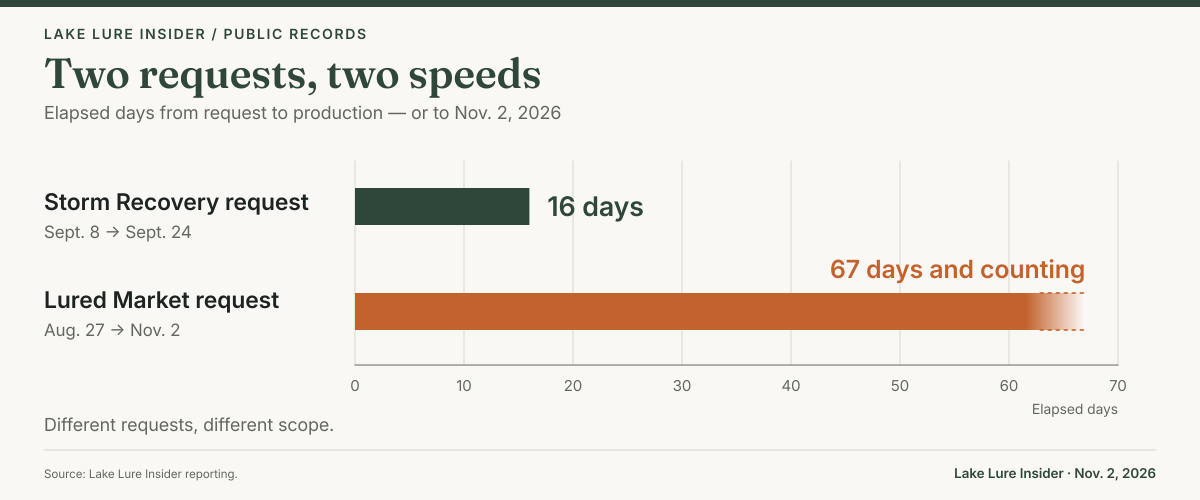
On Monday, Nov. 2, I filed a lawsuit against the Town of Lake Lure in Rutherford County Superior Court (case no. 26CV001777-800). The clerk's stamp shows it was e-filed at 10:57 a.m. I'm asking a judge to order the Town to give me public records I requested 67 days ago, and to tell me in writing what it is holding back and why. This was a hard decision, and not one I made lightly.
Disclosure: I'm the person who filed this case, and I publish Lake Lure Insider as an individual. I'm not a neutral party, so I've linked what I can to documents you can read for yourself.
I should also tell you where I'm coming from. I live in Belmont, N.C., half the year and in Lake Lure the other half. I grew up in Hendersonville, and Lake Lure is where my summers happened. That makes me a part-time resident, and I know some people will say this isn't my fight. The law doesn't see it that way. North Carolina's Public Records Act doesn't ask who you are or why you want a record (G.S. 132-6(b)). Those records belong to everyone.
How I got here
I did not set out to sue anybody. I got involved in Lake Lure politics because of Lured Market.
In August, the Town moved to end the lease of Lured Market & Grill and evict it. I wrote about the fight, published a petition asking the Town to resolve it in the open, and went to the Aug. 26 Council meeting, where roughly 100 people packed the room. From the audience, I asked whether the Council had ever voted to terminate the lease. Nobody answered.
The Town and the Brocks signed a settlement on Sept. 16, and I'm glad they did. If the story had only ever been about one lease, I would have put it down there.
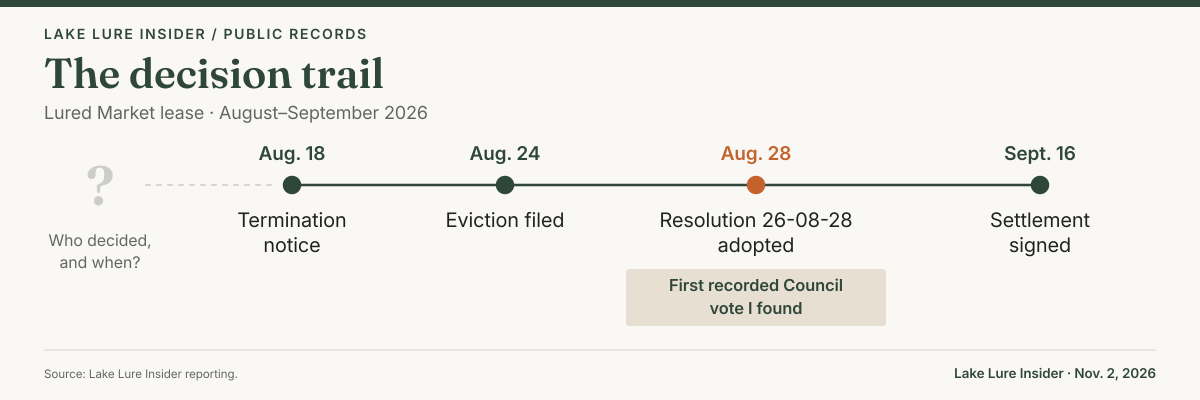
I couldn't, because of that unanswered question. The termination notice is dated Aug. 18. The Town filed to evict on Aug. 24. The first recorded Council vote I have found is Resolution 26-08-28, adopted unanimously on Aug. 28, and it ratifies the termination only if the Town's proposed settlement wasn't accepted. That doesn't prove anything improper. But more than two months later, I still can't tell you from the public record who decided to end that lease, or when. It's a simple question, and a town should be able to answer it.
Why this is no longer about Lured Market
When I couldn't get an answer in the room, I did what the law lets any resident do: I asked for the records. Here's exactly what I asked for, and why. That was Aug. 27.
Somewhere in the weeks after, the lease dispute faded and the records request became the real story for me. Not because of any one document, but because of what the process itself showed:
- At the Oct. 1 candidate forum, Mayor Carol Pritchett told residents that for any documents they want, "you can request for the town to provide them for you, and they will." (Forum coverage.) I took her at her word. That is the standard I'm asking the Town to meet.
- As of that forum, Council meetings weren't being recorded. The Mayor said this is because the Town lost Town Hall and is meeting in temporary space, and that video will return once it's back. For a resident who can't attend, the written record is the only window.
- When I asked, the Town hadn't posted minutes for any Council meeting since July 27, the stretch that covers the lease termination and the eviction filing. (Packed House, No Answers.)
It also isn't about one business. Records I've received from the Town on other requests showed me how much of how Lake Lure works only becomes visible when someone asks for the paper: the Storm Recovery Fund donations, two memorial benches, the beach sand "donation", and the Town's insurance pool suing it over a $2.5 million Helene payment.
The Town gave me the Storm Recovery records 16 days after I asked. I thanked them then, and I mean it now. It's exactly why the silence on this request is so hard to square. The Town has shown it can do this.
Sixty-seven days
Here is what happened, in order. Every item is documented in the exhibits to my complaint, and the first half is laid out in our Oct. 13 report.

- Aug. 27: I emailed the Town Clerk a request in ten categories. I offered to take records a piece at a time, and asked for a cost estimate before any fee.
- Sept. 4: I restated the request, added items, and sent it to the Clerk, the Communications Director, the Town Attorney and the Town Manager.
- Sept. 19: The Town Manager wrote that staff expected to provide records "next week." None came.
- Sept. 24: The Town produced records on a different request I'd filed Sept. 8, and said this one was "currently being reviewed prior to release."
- Oct. 4 and 8: I asked for a release date. The Oct. 8 reply said the process is time intensive and records would come "as soon as possible." No date.
- Oct. 8, that night: I cut my request from 15 categories to five and asked for those by Oct. 14. I also asked the Town to preserve texts and personal-account messages used for Town business.
- Oct. 16: I followed up and set Oct. 23. Nothing came by Oct. 14 or Oct. 23.
- Oct. 29: The Town Clerk replied in writing. The letter cited volume and limited staffing, said the Town would prioritize my five categories and produce in stages, and said it didn't want to give dates it couldn't support. It produced no records and gave no date.
- Oct. 30: I asked once more for something concrete by 9 a.m. Monday. The Town Attorney replied that the Town will produce records "as quickly as practicable," that I wouldn't get everything by Monday, and that he was available for a call. No date.
- Nov. 2, 9:01 a.m.: The Town Attorney wrote again. He said the Town will produce "as quickly as practicable," will withhold documents where the law allows and describe those denials as it produces records in batches, and hasn't worked out any cost yet. No records and no date. It is Exhibit L to the complaint.
I want to be fair to the Town. The Clerk's letter says staff is limited and still carrying hurricane recovery work, and I believe that. But I offered four separate times in writing (Aug. 27, Sept. 4, Sept. 18 and Oct. 4) to take records on a rolling basis. I went from 15 categories to five. A busy office can do five things. What I could not get in 67 days was a date, or a single page.
The five simple things I asked for first
I picked these five because they are existing documents. Nobody has to search a phone or read months of email to find them. I offered to talk about everything else separately. Here is each one, and why I think the Town can hand it over quickly.

- Anything showing the Council authorized ending the lease or filing to evict. That means a resolution, a motion, minutes, or a closed-session account. If the Council voted, a record of the vote exists. State law requires public bodies to keep full and accurate minutes and a general account of every closed session (G.S. 143-318.10(e)). The same law lets a town hold back closed-session minutes while releasing them would defeat the purpose of the closed session, but then it should tell me that. And if no such record exists, "there isn't one" is a one-sentence answer, and an important one.
- Council minutes from July 27 forward. Minutes are records the Town must already keep. Some of what I asked for is now online: approved minutes from several late-August meetings appeared in the Town's Sept. 8 packet and on its website, and I've saved them in our free records archive. I'm glad. But my request also covered drafts and closed-session accounts, and I have never been told in writing what exists.
- Second Mountain's March 2026 records request, and the Town's reply. One request the Town received and whatever it wrote back. Both should be in the Town's files.
- Law-firm invoices and engagement letters. Invoices come in, the Town pays them from public funds, and they sit with finance. I offered to accept them with privileged narrative blacked out. State law says a request can't be denied just because confidential information is mixed in with public information, and that the agency bears the cost of separating them (G.S. 132-6(c)). A dispute that ran through mediation, a lawsuit and an eviction case has a price tag, and taxpayers are the ones paying it.
- Police incident reports and activity logs that mention the boathouse. Police departments log incidents in a records system. Pulling the entries tied to one building should be a search, not a project. I'd expect it to take an afternoon.
I did not put the harder items on the priority list: Council members' texts and personal accounts, and call records from the day of the Aug. 14 mediation. I asked the Town to preserve those, and said I'd take them up later.
If something truly can't be released, or will cost money to produce, the Town can tell me that. I asked for a written statement of anything withheld, the legal basis, and a cost estimate before any fee. The Town's Nov. 2 reply speaks to all three in general terms, but it names no record, no legal basis for any withholding, no cost figure and no date.
What I'm asking the court to do
I'm not asking a judge to decide who was right about the lease, and I'm not asking for money. The case names only the Town of Lake Lure, not any official or employee. The complaint asks the court to:
- Set the case for an immediate hearing. The statute says these cases "shall be set down for immediate hearing" (G.S. 132-9(a)).
- Declare that the records I asked for are public records.
- Order the Town to produce the five priority categories by a date the court sets, and the rest on a schedule the court sets.
- Order the Town to state in writing what it is withholding or redacting, and the legal basis.
- Declare that the delay did not meet the law's standard that records be furnished "as promptly as possible" (G.S. 132-6(a)), and charge court costs to the Town.
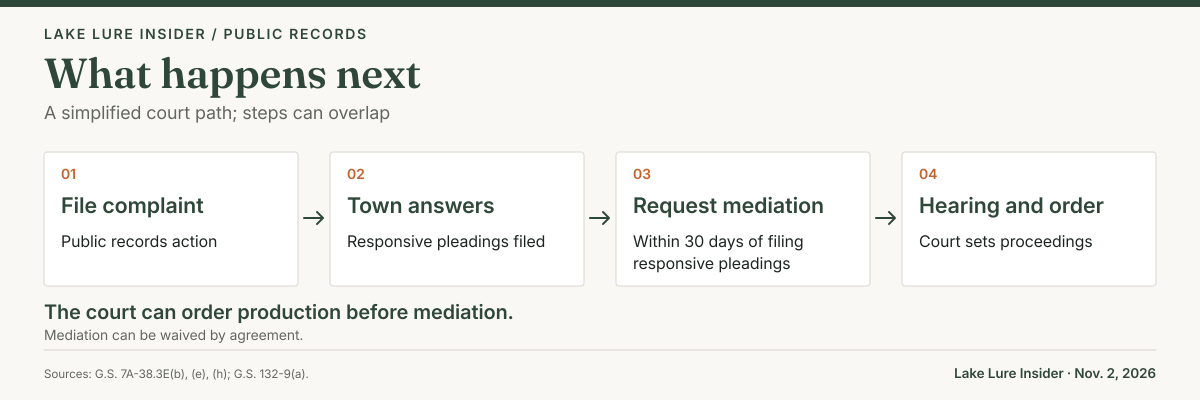
I'm representing myself. I'm not a lawyer, and nothing here is legal advice. People who work on open-government issues told me plainly that cases like this can be slow, and that doing it without a lawyer is hard. State law also requires mediation in these cases (G.S. 7A-38.3E). I will request it, and I will take part in good faith. If the Town hands me the five categories and a written schedule for the rest, I will count that as a win.
Why Monday
I know the timing will raise questions, since I filed the complaint the day before an election. I set the Monday deadline in writing on Friday, Oct. 30, after the Oct. 14 and Oct. 23 deadlines I'd given had passed. The date follows the record, not the ballot. This isn't an endorsement of any candidate, and it isn't aimed at one. Whoever wins Tuesday inherits this request.
I never wanted to be the story
This is the part I'm least comfortable writing. I never wanted to be out in front of these stories. I came to Lake Lure's government as a curious resident, not a crusader. I wanted to learn how this town actually works: how a decision gets made, who makes it, where it gets written down, and what happens between the public meetings. I have a journalism degree and a lifelong attachment to this place, and I figured the way to learn was to ask for the paper.
What I've found is that the paper is the whole game. Lake Lure is a small town with a small staff, still recovering from Helene, and I'm asking the Town, not any one person, to answer a request. I take no pleasure in this. I would much rather be writing about the dam, the beach and Edmund the goat.
What I'm hoping for is simple. Records in the open. A written schedule. A Town that treats a records request the way the Mayor told residents it would on Oct. 1. If the records arrive, I'll report what they show, whether it flatters the Town or not, and I'll update this page. If you have a records problem of your own with the Town, tell me.
Supporting documents
Everything above links to something you can read yourself. Here is the full set, grouped.
The request and the 67 days
- Here's Exactly What We Asked the Town for, and Why (Sept. 8): all 15 categories, in plain language
- Lake Lure Has Sat on a Public Records Request for 47 Days (Oct. 13): the timeline through the first deadline
- The complaint and Exhibits A through L (PDF): file-stamped by the Clerk of Superior Court on Nov. 2, 2026 (case no. 26CV001777-800), with my telephone number blacked out.
The Lured Market record
- Every Document in the Lured Market Story: a running index of court filings, Town documents and our coverage
- Packed House, No Answers (Aug. 26)
- Filed at 3:27 P.M., Before the Hearing, Not After (Aug. 25)
- The Meeting No One Saw End (Aug. 28)
- What the Town's New Statement Leaves Out: Resolution 26-08-28 (Sept. 6), and the Town's Aug. 28 minutes, as posted
- Signed: Lake Lure and Second Mountain Settle (Sept. 17)
Why it's bigger than one lease
- Storm Recovery Fund, Part 1: the donations, Part 2: the benches, Part 3: the beach sand
- Lake Lure's Own Insurer Is Suing the Town and the $2.5 million Helene check
- The Oct. 1 candidate forum
- Search every Lake Lure town meeting document: free, and saved so it can't disappear
The law
- G.S. 132-6: inspection and copies "as promptly as possible"
- G.S. 132-9: going to court, and the "immediate hearing" requirement
- G.S. 7A-38.3E: mediation of public records disputes
- G.S. 143-318.10: minutes and closed-session accounts
Last updated: 2026-11-02