
Lake Lure's Own Insurer Is Suing the Town, and the Company That Adjusted Its Helene Claims
Investigation, Part 1 of 2 — Lake Lure, NC — October 13, 2026
Photo: Lake Lure Insider and Rutherford County, NC Emergency Management
Based on the public court file in Wake County Superior Court case 26CV035241-910, including the plaintiff's motion to seal, its index of exhibits and the three exhibits it filed publicly; 166 Town of Lake Lure Council packets and minutes from September 2024 to October 2026; the Town's published storm-recovery updates; and public records on the N.C. League of Municipalities and Sedgwick. The lawsuit was first reported by Annie Dance at Cops & Congress. Lake Lure Insider is sending written questions to the Town, the League and Sedgwick; their responses will be added here when they arrive. Every document we cite is linked inline, and the court filings are hosted on this site.
LAKE LURE, N.C. — The insurance pool that covers the Town of Lake Lure's buildings has sued the Town.
On Sept. 17, the Interlocal Risk Financing Fund of North Carolina filed suit in Wake County Superior Court against Lake Lure and Sedgwick Claims Management Services, the company the fund hired to adjust Hurricane Helene claims. The fund is run by the N.C. League of Municipalities, the statewide association Lake Lure belongs to. The case is Interlocal Risk Financing Fund of North Carolina v. Sedgwick Claims Management Services, Inc. and the Town of Lake Lure, No. 26CV035241-910.
The complaint itself is sealed. But the court file lists the claims as breach of contract, indemnification and "money owed." The fund has demanded a jury trial against both defendants.
The Town has not announced the lawsuit. But it has discussed it behind closed doors. On Sept. 23, six days after the suit was filed, Council went into closed session "in regards to Second Mountain LLC and Interlocal Risk Financing Fund, NC," according to the draft minutes of that meeting published in the Oct. 13 Council packet. Council's Oct. 13 agenda also ended with a closed session "for Attorney Client Privilege or Legal Claims."
Why it matters: the exhibits filed with the complaint point to the insurance money Lake Lure collected after Helene. The Town's own records show that money is already in dispute, and the Town is counting on it to rebuild its flooded Town Hall.
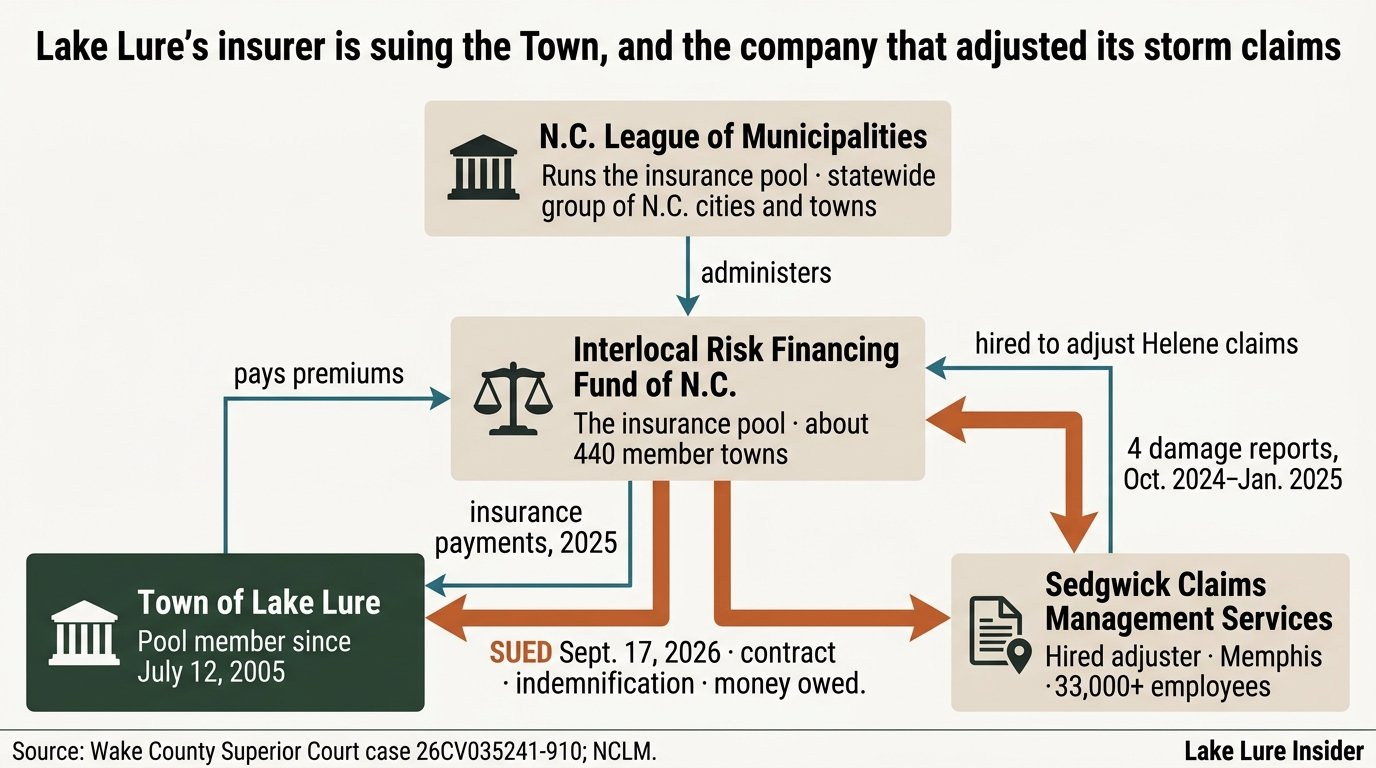
Who's suing whom. Source: N.C. eCourts, case 26CV035241-910. Graphic: Lake Lure Insider.
What the court file shows
The public file is thin, but it names every document the fund relies on. According to the fund's index of exhibits, it sealed 10 of them and made three public.
| Exhibit | Document | Status |
|---|---|---|
| A | Sedgwick's contract with the fund for catastrophe adjusting in North Carolina | Sealed |
| B | Sedgwick's first report, Oct. 23, 2024 | Sealed |
| C | Lake Lure's 2005 resolution joining the fund, and the Interlocal Agreement | Public |
| D | The fund's Building and Personal Property Coverage Form | Public |
| E | The fund's Flood Coverage Endorsement | Public |
| F | Nov. 6, 2024 email from Sedgwick's executive general adjuster about "the claims list" | Sealed |
| G | Sedgwick's second report, Nov. 21, 2024 | Sealed |
| H | Nov. 21, 2024 email from the same adjuster about "updated directives" | Sealed |
| I | Dec. 31, 2024 email from the adjuster about the third report | Sealed |
| J | Sedgwick's third report, Dec. 31, 2024 | Sealed |
| K | Sedgwick's fourth report, Jan. 27, 2025 | Sealed |
| L | Feb. 4, 2025 email from League claims staff "regarding looking at the dam" | Sealed |
| M | Feb. 4, 2025 email from Sedgwick's adjuster "regarding looking at the dam" | Sealed |
The timeline matters. Sedgwick filed four reports between October 2024 and January 2025. The Town reported receiving half its insurance money by Jan. 7, 2025. A week after Sedgwick's last report, League claims staff and Sedgwick's adjuster were emailing about the dam.
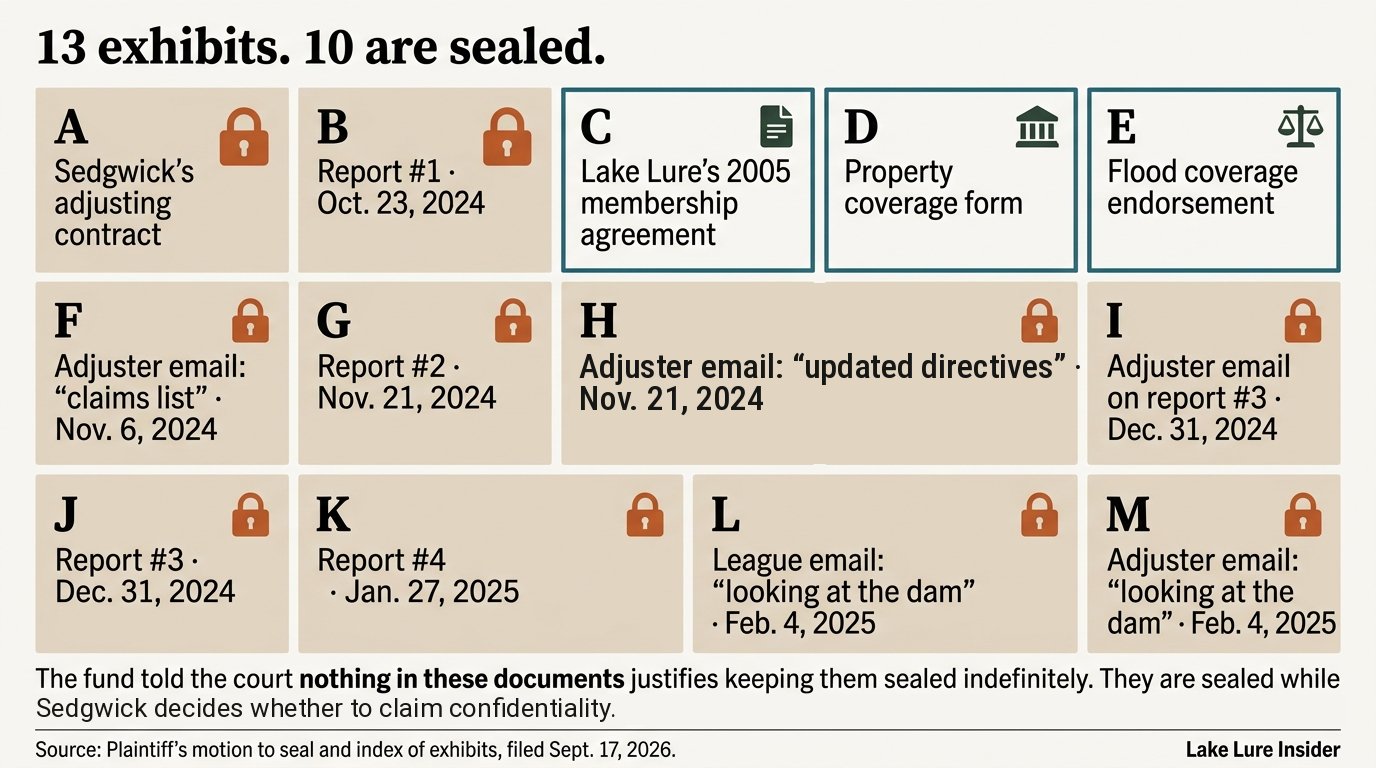
What's in the court file. Source: plaintiff's index of exhibits, filed Sept. 17, 2026. Graphic: Lake Lure Insider.
The Town was served Sept. 24; Sedgwick, Sept. 28. Both accepted service in filings dated Oct. 7. Under the usual 30-day rule, answers would be due around Oct. 24 and Oct. 28, but extensions are routine.
The lawyers: the fund is represented by Poyner Spruill of Raleigh (J. Alexander S. Barrett, Kurt A. Seeber, Daniel G. Cahill). Sedgwick: Kimberly Dawn Grande. The Town: Thomas Martin "Marty" Benson, Derek J. Allen and James Brandon Freeman.
Who's who
The N.C. League of Municipalities (NCLM). Founded in 1908 as the Carolina Municipal Association, it is the statewide membership group for North Carolina cities and towns. It lobbies the General Assembly, trains local officials and runs self-funded insurance programs for its members: workers' compensation, employee health benefits, and property and liability coverage. It administers the fund that filed this suit. (About the League)
The Interlocal Risk Financing Fund of North Carolina (IRFFNC). Also called the Property and Casualty Trust. It was formed in the mid-1980s, when commercial insurers were pulling back from local governments. It is not an insurance company. It is a pool: member towns pay premiums into a shared fund, and the fund pays covered losses. A board of trustees oversees it; League staff handle underwriting and claims. Lake Lure joined in July 2005. After Helene, the League reported more than 300 claims statewide, about $45 million in covered exposures. (Property & Casualty Trust · NCLM 2024 annual report)
Sedgwick Claims Management Services, Inc. A Memphis-based claims-handling and adjusting company, among the largest in the world. Insurers and self-insured groups hire it to inspect damage, value losses and recommend payments. The private-equity firm Carlyle has been majority owner since a $6.7 billion deal in 2018; a 2024 investment valued it at about $13.2 billion, with more than 33,000 employees in 80 countries. Its CEO is Mike Arbour. The fund hired Sedgwick for catastrophe adjusting in North Carolina.
The Town of Lake Lure. The insured member. Its finance staff and its FEMA-and-insurance consultant, ICF, handled the Helene claims. Then–Finance Director Stephen Ford led the insurance work. The Town is now recruiting a new finance director, and Town Manager Olivia Stewman has served as interim finance officer since Sept. 23.
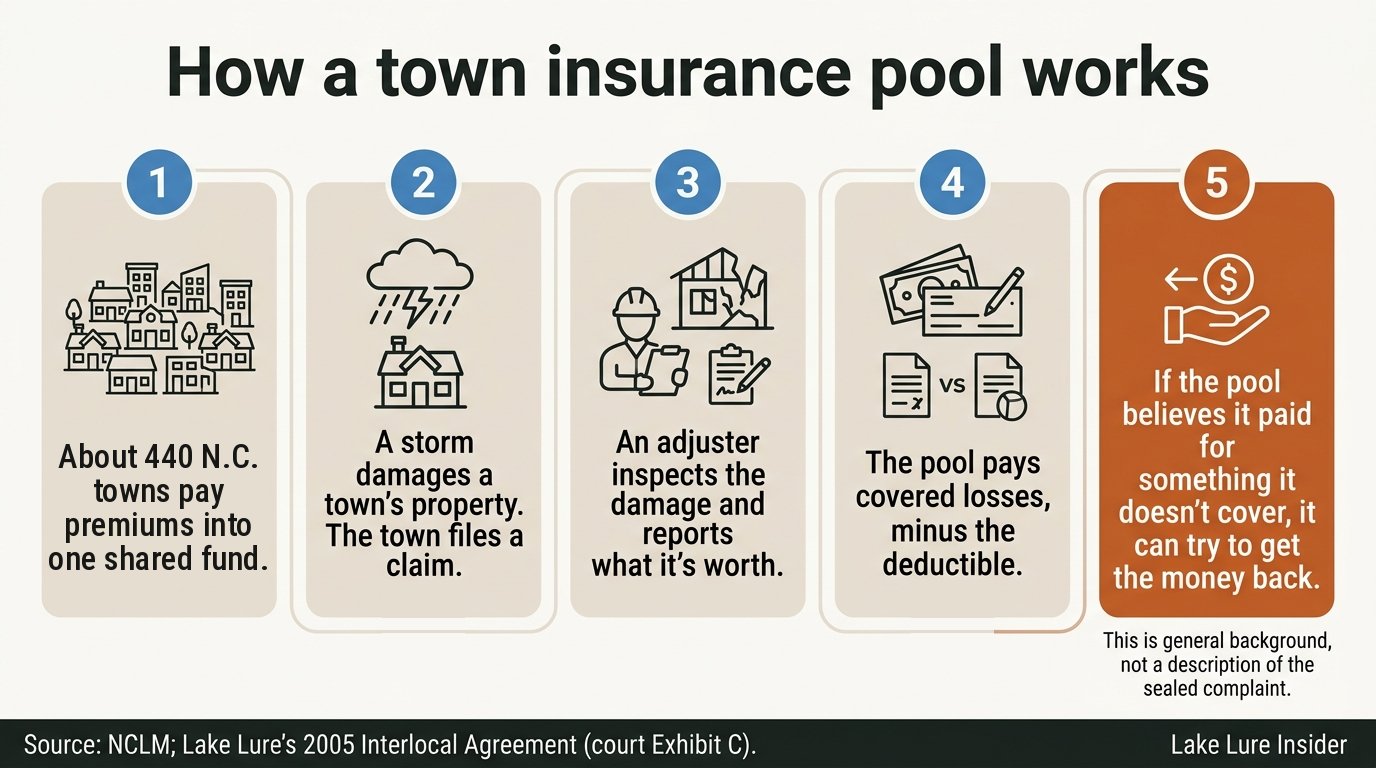
How an insurance pool works. Sources: NCLM; Exhibit C, Interlocal Agreement. Graphic: Lake Lure Insider.
What Lake Lure's policy covers, and what it doesn't
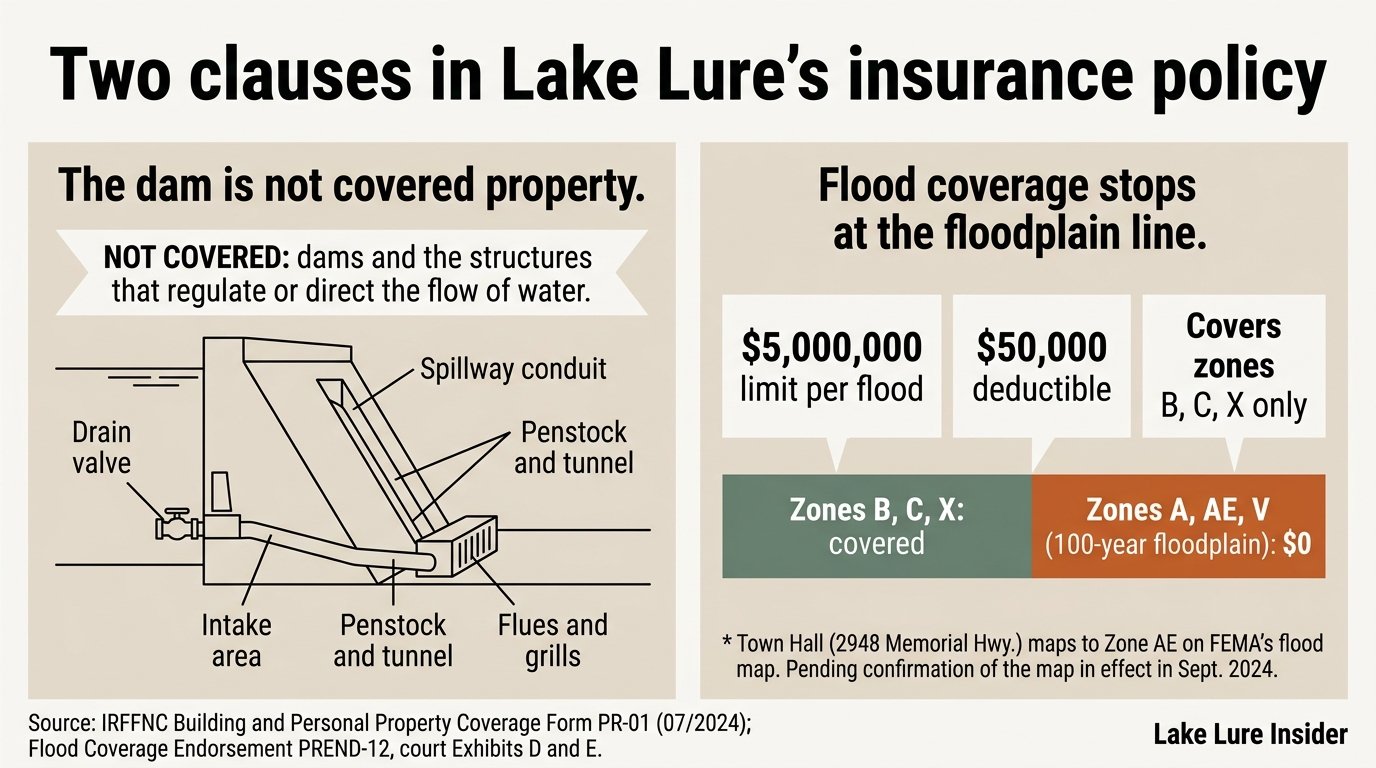
The fund made three exhibits public, and they read like an outline of its argument. Two clauses stand out.
The dam is not covered property. The fund's property form (version PR-01, July 2024) lists what it does not insure. Near the top: "Dams, levees or dikes and the related structures that regulate or direct the flow of water, including but not limited to the drain valve, intake area, spillway conduit, penstock and tunnel, flues, and grills." That is close to a parts list for Lake Lure's dam and its hydroelectric intake. The same page excludes most bridges, roadways, and piers and docks not listed on the Town's property schedule.
Flood coverage stops at the floodplain line. Ordinary property coverage excludes flood. Lake Lure carried a flood endorsement, but it is narrow:
- Limit: $5,000,000 per flood and per year. That matches the "up to $5,000,000" in insurance the Town told residents to expect in December 2024.
- Deductible: $50,000 per flood.
- Where it applies: only in FEMA flood zones B, C and X. The endorsement says the fund "will not pay for loss or damage to any covered property... located in any location either wholly or partially in flood zones A, V, or a one hundred (100) year Flood Plain." (Exhibit E, p. 3)
- Also excluded: boathouses and other structures over water.
Where is Town Hall? Lake Lure's Town Hall at 2948 Memorial Highway was flooded in Helene. Lake Lure Insider checked the address against FEMA's National Flood Hazard Layer, which places it in Zone AE, the 100-year floodplain. If that holds for the map in effect in September 2024, Town Hall would have had no flood coverage under this endorsement. We are asking the Town to confirm it. These forms are also not the whole policy: coverage applies only to property on the Town's schedules, and other endorsements could change the picture.
If the fund pays, it can collect. Members must cooperate with the fund and its contractors. If the fund pays a loss, it takes over the member's right to recover from anyone responsible, and any recovery or salvage goes to the fund "until the sum paid by IRFFNC has been recovered." (Exhibit D, p. 11)
The money trail in the Town's own records
Lake Lure Insider reviewed 166 Town Council packets and minutes from September 2024 to October 2026, plus the Town's storm-recovery updates. The Town never reported its insurance receipts as a separate public line. But the record shows how the money was described, and how that description changed.
| Date | What the Town record says | Source |
|---|---|---|
| Oct. 14, 2024 | "The NCLM insurance is coming today to look at damages." | Council briefing minutes |
| Oct. 23, 2024 | The dam's reservoir-drain contractor, Morgan Corporation, "has insurance for the damages sustained related to the reservoir drain valve project." | Work session minutes |
| Nov. 12, 2024 | Ford was "working with the insurance company on the claims assessment. He stated that he should not have made any speculations regarding the insurance coverage." | Council minutes |
| Nov. 20, 2024 | Ford: "ICF has been a lot of help with the insurance and we have had significant response from the League." | Work session minutes |
| Dec. 12, 2024 | Insurance proceeds "Up to $5,000,000," with 50% approved for release. | Storm recovery update |
| Dec. 16, 2024 | Ford reports "Great news today with a 2.5 million dollar check from insurance came in. It will be deposited immediately." | Council briefing record (Jan. 22, 2025 packet, p. 15) |
| Jan. 7, 2025 | "50% of insurance payments received." | Storm recovery update |
| Jan. 31, 2025 | "$1.3 million insurance payment received for damage to Town Hall." | Storm recovery update |
| Mar. 28, 2025 | Ford: state loan deposited; "Still working on the insurance portion." | Work session minutes |
| Aug. 2025 | Storm debris damaged Engine 2510, the first-out fire engine; "filed as an insurance claim." | Council packet, p. 27 |
| Apr. 6, 2026 | "FEMA's current damage estimate for the old town hall is under $37,000... Legal disputes with insurance complicate available funds, with about $100,000 paid but contested regarding additional payments." | Storm recovery minutes, p. 3 (Town copy) |
The contradiction. In January 2025 the Town announced a $1.3 million payment for Town Hall. Fourteen months later, its own minutes put the figure at "about $100,000 paid but contested." The Town has not publicly explained the difference.
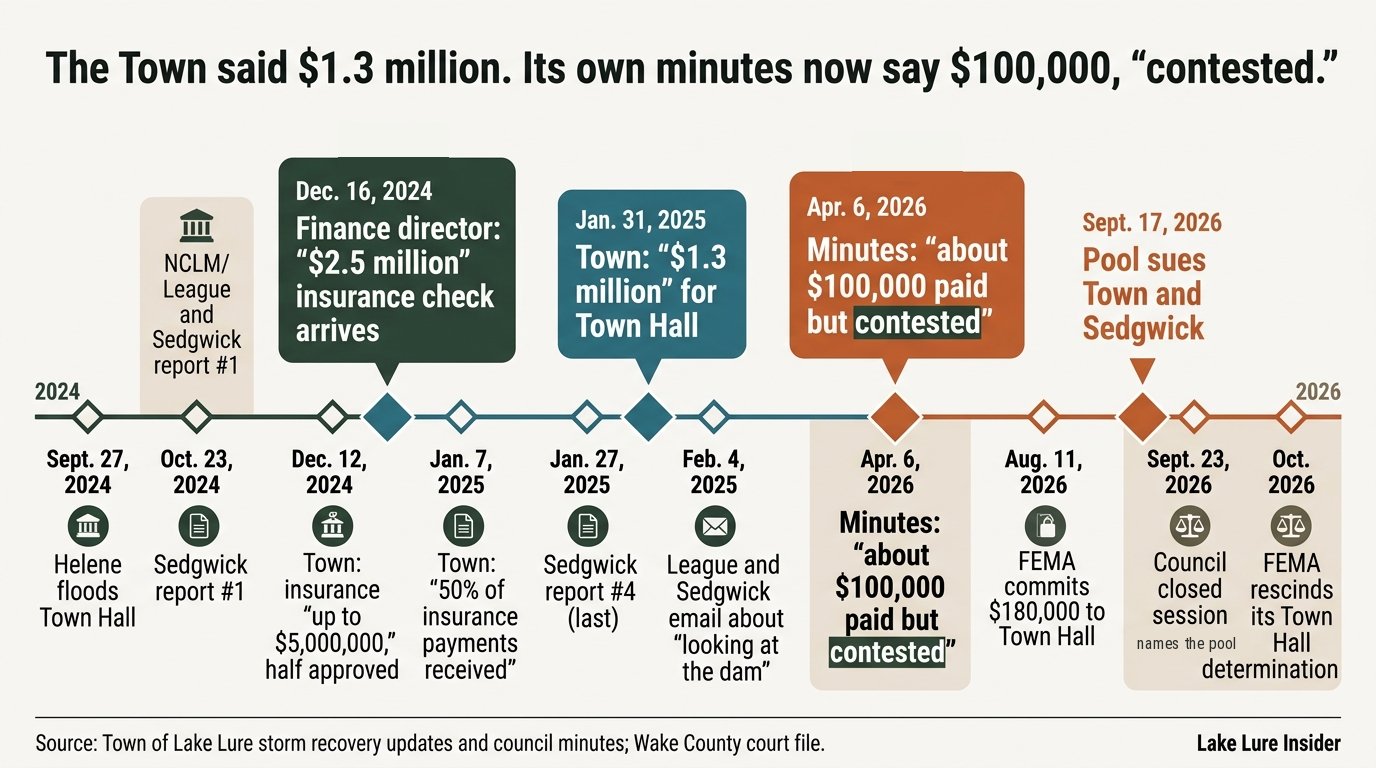
The Town Hall money, in the Town's own words. Sources: Town Council minutes and storm-recovery updates linked in the table above; N.C. eCourts. Graphic: Lake Lure Insider.
What the Town's books show. Two items stand out in the Town's monthly revenue statements:
- The storm recovery fund (Fund 20). By Feb. 25, 2025, it showed $2,655,751 in "other revenues". That was before the Town said it had received any FEMA reimbursement, and before a $3.4 million state loan arrived in March.
- The General Fund's miscellaneous revenue line. It reached $1,383,604.96 by February, against a full-year budget of $30,458. By May 2025 it had fallen to $264,376.02. About $1.12 million was moved out between March and May, with no explanation in any council packet we reviewed.
The first entry lines up with a confirmed payment: the Dec. 16, 2024 "2.5 million dollar check from insurance." That is half of the $5 million flood limit, and it matches the Town's "50% received" note. Whether the $1.3 million for Town Hall was a second payment or part of the same money is not clear from the records, and the two figures should not be added together without the Town's confirmation. The Town's audit for the fiscal year that would show these receipts, the year ended June 30, 2025, has not been completed.
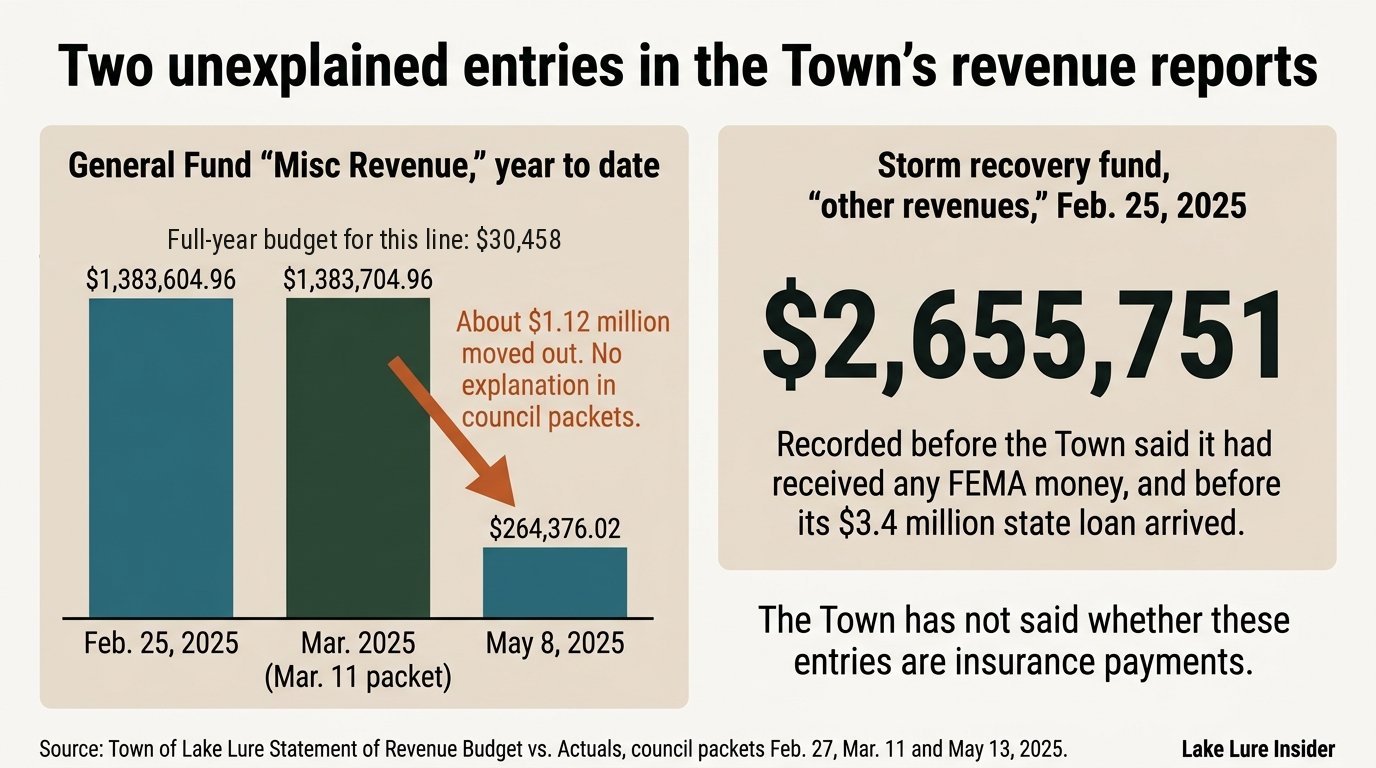
The money in the Town's books. Sources: Town revenue reports in the Feb. 27, 2025 and May 13, 2025 Council packets. Graphic: Lake Lure Insider.
Why the case is sealed, and for how long
The complaint is sealed to protect Sedgwick's business information, not the Town's. And the fund itself says it shouldn't stay that way.
The fund filed under Rule 27 of North Carolina's General Rules of Practice, which lets a filer submit documents "provisionally under seal" while the court decides. In its motion to seal, the fund said the complaint and exhibits do not contain its own confidential or proprietary business information, and that it "does not believe they contain any information that justifies the documents remaining under seal indefinitely." It sealed them only because Sedgwick "may believe" they contain Sedgwick's confidential business information, chiefly its adjusting contract and reports. Until a judge rules, only the lawyers can see them.
The clock. Under Rule 27, anyone served with the motion has 20 days to file a brief supporting or opposing sealing; Sedgwick was served Sept. 28. A hearing follows. If no one justifies sealing, the court "may order that the document... be made public." As of Oct. 13, no order had been entered.
The legal standard. North Carolina's constitution guarantees open courts. Under the state Supreme Court's 1999 Virmani decision, a judge may seal court records only for a compelling interest, after considering alternatives, and with written findings. A contractor's pricing might qualify. A dispute over how public money was paid out generally would not. (RCFP Open Courts Compendium, N.C.)
The public can ask. Under G.S. 1-72.1, any person, including a news outlet, may file a limited motion asserting a right of access to sealed court records without becoming a party to the case.
Has the League been here before?
We found no record of the League investigating, auditing or suing Lake Lure before this case. Lawsuits by the fund against its own members appear rare; the one appellate case we found, from 2007, was a coverage fight over a police officer, not a suit against a town (Interlocal Risk Financing Fund v. Ryals).
What the record does show is a close working relationship, which makes the lawsuit more striking:
- Oct. 14, 2024: League insurance staff came to inspect Helene damage.
- Nov. 20, 2024: the finance director told Council the Town had "significant response from the League."
- Sept. 9, 2025: Council approved a disaster-recovery agreement under which the League, using state Helene money, provides the Town legal help through the Raleigh firm Parker Poe.
- Sept. 23, 2026, six days after the suit was filed: Council met in closed session about the fund's case, and in open session was told the League "provides significant insurance coverage and risk management services to the Town," and that personnel policies meeting League minimum standards are "important for continued eligibility and compliance." The new policy was on Council's Oct. 13 consent agenda.
The League is now, at once, the Town's insurer, its disaster-recovery legal provider and its opponent in court.
What could be happening (analysis)
This section is analysis. The complaint is sealed, and none of these explanations has been confirmed.
The likeliest explanation is that the fund believes it paid Lake Lure for losses its policy didn't cover, and wants that money back from the Town and from Sedgwick, whose adjusting led to the payments. The claim types fit that reading: "money owed" points at the Town, while "contract" and "indemnification" point at Sedgwick's adjusting agreement. Three versions are plausible, and they are not mutually exclusive.
1. Town Hall and the floodplain. Sedgwick adjusts the Town's losses; the fund pays an early installment, including what the Town called $1.3 million for Town Hall. The fund then concludes Town Hall sits in Zone AE, where its flood endorsement pays nothing. For: the floodplain clause is in a public exhibit, and the Town's own minutes now call the Town Hall money "contested." Against: no public exhibit mentions Town Hall by name.
2. The dam. Sedgwick's reports may have valued damage to dam structures the policy expressly excludes: the drain valve, intake, spillway conduit and penstock. On Feb. 4, 2025, a week after Sedgwick's final report, the League and Sedgwick were emailing about "looking at the dam." Damage to the drain-valve project may also have been covered by the contractor's own insurance. For: two sealed exhibits concern the dam, and the exclusion reads like a description of it. Against: we have no record that the fund paid anything on the dam.
3. A fight mainly with the adjuster. The core dispute may be the fund against Sedgwick over how it handled catastrophe claims, with the Town named because it received the disputed money. Exhibits about a "claims list" and "updated directives" suggest an argument over what Sedgwick was told to adjust. For: Sedgwick is the lead defendant, and sealing turns on its position. Against: if only one member town was sued, Lake Lure's own claims are likely at the center.
What we considered and set aside: a defense of the Town against outside lawsuits (the docket lists no declaratory-judgment claim, and the exhibits are about adjusting the Town's own losses), and unpaid premiums (that dispute would not need Sedgwick or the dam).
What it means for Town Hall, the budget and residents
If the fund wins money back, taxpayers cover the gap, and Town Hall is the project most exposed.
Town Hall is already short of money. The Memorial Highway building has been out of service since Helene; Council now meets at what its agendas call "Town Hall at The Landings." Here is how the funding picture has moved:
| Date | Town Hall funding status | Source |
|---|---|---|
| Jan. 31, 2025 | Town announces "$1.3 million insurance payment" for Town Hall | Storm recovery update |
| Mar. 16, 2026 | $428,000 in FEMA alternate-project funding available, not yet obligated | Storm recovery minutes |
| Apr. 6, 2026 | FEMA estimate under $37,000; insurance "about $100,000 paid but contested" | Storm recovery minutes, p. 3 |
| Aug. 11, 2026 | FEMA commitment of $180,000 vs. about $202,000 for initial work; Town weighing FEMA "428" alternate funding | Council minutes |
| Oct. 2026 | Interior demolition under way; FEMA "has rescinded its previous determination memorandum for the building" | Oct. 13 packet, p. 14 |
Insurance and FEMA are linked. FEMA must subtract any insurance money a town receives for a building (FEMA, duplication of benefits). Its rules also generally reduce aid for an uninsured building in a mapped floodplain by what a federal flood policy would have paid. So a fight over the Town Hall insurance money could change what FEMA will pay, in either direction.
The General Fund has little slack. On Oct. 13, Council was asked to approve using $433,717 of fund balance for a fire-truck down payment. The Town's insurance line for this fiscal year already shows $257,021 paid against $210,000 budgeted. Any repayment to the fund, plus the Town's own legal fees, would come from the same place.
Residents feel it four ways:
- Taxes or delays: money repaid to the fund is money not spent on recovery, or that must be raised another way.
- Premiums: pool losses are shared. Disputed payouts can push up what every member town pays, Lake Lure included.
- Transparency: the Town announced its insurance money in 2025 but has said nothing publicly about the lawsuit.
- Audits: the Town's audit for the year ended June 30, 2025, which would show these receipts, is not done. A repayment demand is the kind of liability auditors must report.
Did the Town follow protocol when it joined?
Yes, as far as the public record shows, and joining a League pool is what most North Carolina towns do.
The 2005 paperwork looks routine. Exhibit C is Resolution No. 05-07-12C, adopted by the Lake Lure Town Council on July 12, 2005. It is signed by then-Mayor Jim Proctor, now a commissioner on the November ballot, attested by Town Clerk Mary A. Flack, and bears the Town seal. It approves the standard "Interlocal Agreement for a Group Self-Insurance Pool," dated the same day. That is the process the League's own form calls for: a council resolution, then execution by the authorized officials. A mayor signing a resolution the council adopted is the normal role. Nothing in the record suggests Proctor acted alone or outside his authority. We are requesting the minutes of the July 12, 2005 meeting to confirm the vote.
Pooling is common practice. The League's pools were created in the mid-1980s, when commercial insurers raised prices or stopped covering local governments. Today the League's Property and Casualty Trust serves about 440 member municipalities, and its workers' compensation pool serves 477 (NCLM). State law, G.S. 58-23-5, expressly lets two or more local governments pool their risks, with notice to the state Insurance Commissioner.
What's uncommon is the lawsuit. A pool suing one of its own members, alongside the adjuster it hired, is rare. The more pointed questions are about 2024 and 2025: how the Town documented its losses, how flood zones and the dam were handled in the claim, and why its public statements about the insurance money changed.
What we're asking, and what comes next
Questions for the Town:
- How much insurance money did the Town receive for Helene, when, and for which buildings?
- Was $1.3 million received for Town Hall, as announced in January 2025? Is the "about $100,000 paid but contested" in April 2026 about the same building?
- What was the roughly $1.12 million moved out of the General Fund's miscellaneous revenue line between March and May 2025?
- Has the fund demanded repayment? How much, and when?
- Is Town Hall in a FEMA special flood hazard area? Did it carry a federal flood policy?
- Why hasn't the Town told residents about the lawsuit?
Questions for the League and its lawyers at Poyner Spruill: How much is the fund seeking, and from whom? Is this the only member suit arising from Sedgwick's Helene work?
Questions for Sedgwick: Will it ask the court to keep the complaint sealed?
| Date | What happens |
|---|---|
| Oct. 15, 2026 | Early voting opens |
| About Oct. 18, 2026 | Rule 27 deadline for briefs on sealing (20 days after Sedgwick was served) |
| About Oct. 24, 2026 | Town's answer due, unless extended |
| About Oct. 28, 2026 | Sedgwick's answer due, unless extended |
| Nov. 3, 2026 | Election Day |
| Nov. 10, 2026 | Next regular Town Council meeting |
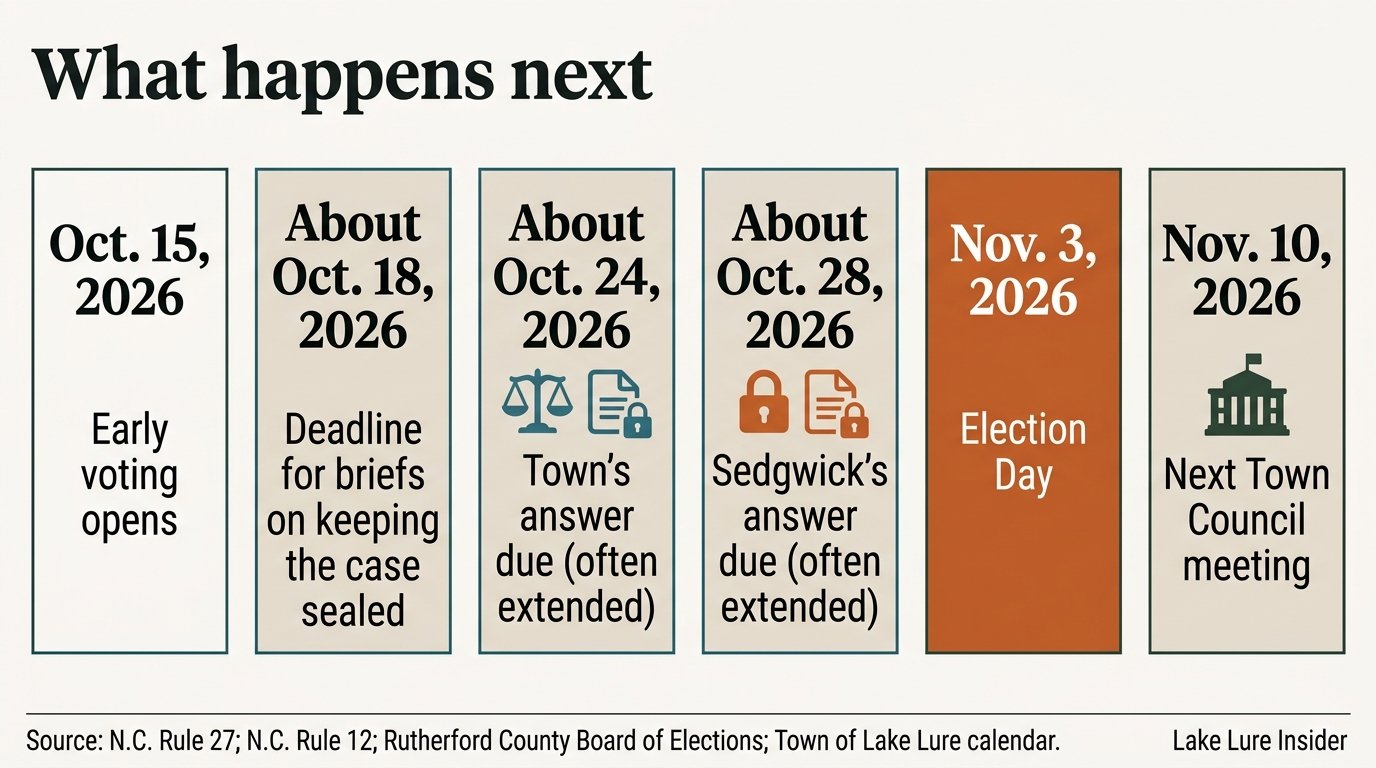
What happens next. Deadlines are estimates under the standard court rules and may be extended. Graphic: Lake Lure Insider.
Part 2 of this series will follow when the complaint is unsealed or the Town and the League answer: what the pool actually claims, how much it wants, and what it means for Town Hall.
Read the Documents
Court filings, hosted on this site:
- Plaintiff's motion to seal, Sept. 17, 2026
- Plaintiff's index of exhibits, Sept. 17, 2026
- Exhibit C: Lake Lure Resolution No. 05-07-12C and the Interlocal Agreement (2005)
- Exhibit D: IRFFNC Building and Personal Property Coverage Form (PR-01, 07/2024)
- Exhibit E: IRFFNC Flood Coverage Endorsement
- N.C. eCourts portal (search case 26CV035241-910)
Town of Lake Lure records:
- Storm recovery minutes, Apr. 6, 2026 (Town copy)
- Council briefing records, December 2024, from the Jan. 22, 2025 packet (full packet)
- Oct. 13, 2026 Council packet
- Sept. 23, 2026 work session packet
- Town of Lake Lure meetings archive
Have a question, a tip, or a document we should see?
Contact Lake Lure Insider
Last updated: 2026-10-13