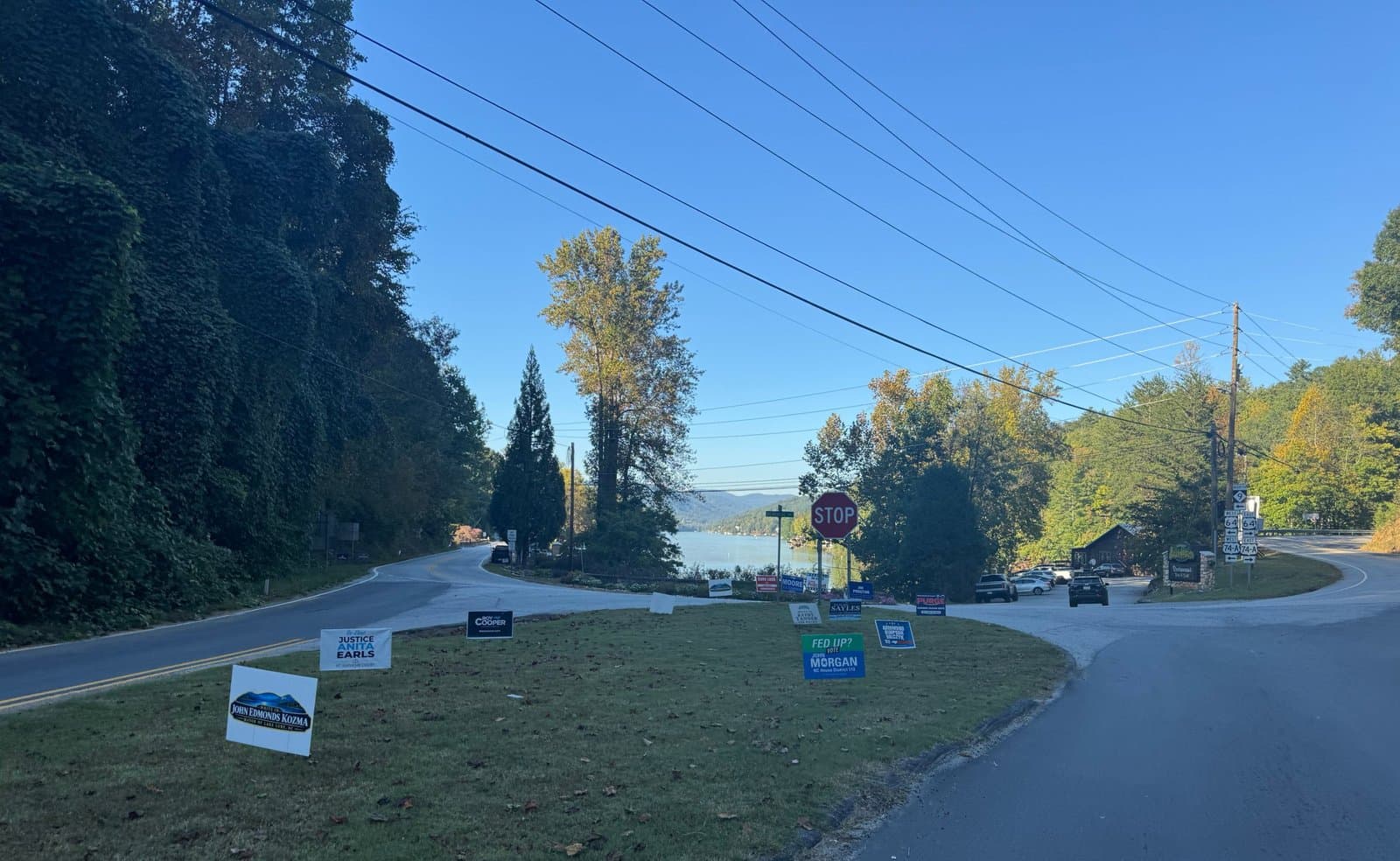
Planted: The Long, Stubborn Life of the Political Yard Sign
Explainer — Lake Lure, NC — October 14, 2026
Photo: Lake Lure Insider
Every October the kudzu browns and a different crop comes up along the roadsides. Where yard signs came from, whether they win votes, how the law treats them, and what Lake Lure's rules say about yours.
Once the first frost knocks the kudzu back, the shoulders of Memorial Highway and the lawns around the lake stop looking green and start looking printed. Early voting opens Thursday, October 15, and runs through Saturday, October 31. Election Day is Tuesday, November 3. The signs are already up.
They are one of the oldest, cheapest and most argued-over tools in American politics. Campaign consultants complain about them. Political scientists have measured them. Courts have ruled on them more than once. Most people reading this have a strong opinion about the one in their neighbor's yard.
This is a look at where they came from, whether they do anything, how the law got to where it is, and what the rules are here in town.
Where yard signs came from
Writing on walls to sway public opinion is ancient. The walls of Pompeii were covered with painted notices for markets, rentals and lost property, and Scientific American's anthropology blog has traced the lineage of lawn signs back to that habit.
The American story is murkier. The date most often cited is 1824, when John Quincy Adams reportedly had signs printed for his presidential run. That claim comes up again and again, but the same coverage notes that historians and political scientists disagree on when Americans actually began using yard signs. The sign most of us picture today, a printed panel on a wire stake pushed into the lawn, is a far more recent arrival, and the sources don't agree on exactly when it caught on.
Another influence came from the roadside. Burma-Shave, the brushless shaving cream company, began putting up short rhyming roadside signs in a remote part of Minnesota for a few hundred dollars, and the sales results kept the campaign running along American highways for about four decades. It ended when the interstate era changed how people traveled. The lesson that small, simple signs seen at driving speed can work was not lost on politicians. In Canada the company's name even became a campaign term: "burma-shaving" means a candidate standing by the road holding a sign for passing cars.
The materials changed later. Steve Grubbs, an Iowa political operative, launched VictoryStore.com in 1999 and built a business on die-cut corrugated plastic, the lightweight material that now makes up most of the signs you see. At scale they are cheap. A 2016 snapshot priced a 2,000-sign order, with metal stakes included, at about $3.07 per sign. Today, a 100-sign order of 18x24 plastic signs with stakes runs roughly $3.85 each at one online printer, before shipping, so the economics haven't changed much.
Signs have also changed in when they appear. Ball State political scientist Chad Kinsella has observed that signs used to track the campaign season and come down afterward. He ties the shift to what Stanford's Morris Fiorina called the "permanent campaign" almost three decades ago, the idea that campaigning never really stops. Today some signs stay up long after the election they were printed for.
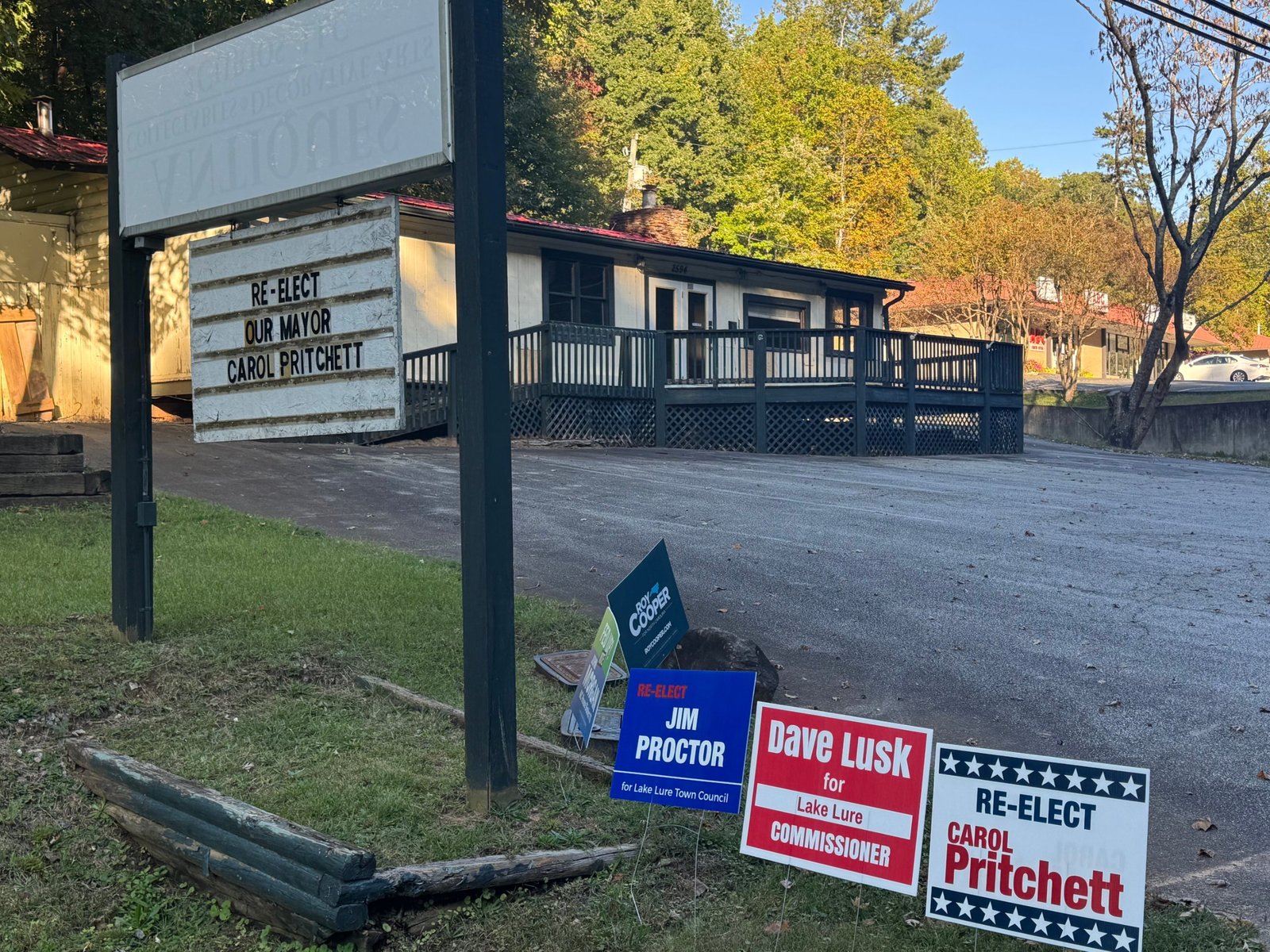
Do they actually work?
Ask campaign professionals and you will often hear no. Political consultant David Mowery, writing for Campaigns and Elections in 2014, argued that signs drain budgets and volunteer time and do little for name identification, message or turnout. Research suggests the truth is somewhere in between.
The name-recognition experiment. In 2011, Vanderbilt political scientists Cindy Kam and Elizabeth Zechmeister printed yard signs for a candidate who did not exist, "Ben Griffin," and planted four of them near a Nashville elementary school during a city council race. When they later surveyed parents who drove past, about a quarter of those exposed listed the fictional candidate among their top three at-large picks. In the control group the figure was about 14 percent. The full study ran in the American Journal of Political Science in 2013, along with lab experiments. Their conclusion: in low-information races, simple name recognition raises support. They also found the effect fades once voters get more meaningful information, such as whether someone is an incumbent.
The precinct experiments. The most rigorous test is a 2016 paper by Donald Green of Columbia and colleagues, published in Electoral Studies. They worked with four real campaigns (a congressional candidate, a mayoral candidate, an independent-expenditure campaign against a gubernatorial candidate, and a county commissioner candidate) and planted signs in randomly selected voting precincts. Pooled across the four experiments, signs raised the advertised candidate's vote share modestly. The paper's highlights put the average at about 1.7 percentage points, though Journalist's Resource summarized it as slightly more than one point, so the exact figure depends on how the pooled estimate is framed. The authors also found some evidence of spillover into neighboring precincts that got no signs, and signs that mentioned a party seemed to work less well than signs that did not.
That is a small effect, comparable to other low-tech tactics like direct mail. It also matters in a close race. A point or two is the difference in many local contests.
What this suggests:
- Signs build familiarity, not persuasion. They matter most in low-information races such as county commissioner, school board, judge and town council, where many voters know little about the candidates.
- Simple beats cluttered. NPR's reporting on the research notes evidence that a crowded message can do more harm than good.
- Signs also work on supporters. In the same NPR report, a campaign figure said loyal volunteers had griped that a past candidate "didn't even have a yard sign." Visible signs signal viability and keep volunteers motivated.
- Presidential races are a different matter. Political scientists have long been skeptical that signs move voters at the top of the ticket.
Do signs unite or divide?
Signs are also a way of talking to your neighbors without talking to them, and the research suggests the result is more mixed than the horror stories imply.
The most extensive work comes from political scientists Todd Makse, Scott Minkoff and Anand Sokhey, authors of Politics on Display. They tracked yard signs across roughly 30,000 households, four elections and three sites (two in Ohio, one in Broomfield, Colorado), as described by the University of Colorado. A few findings stand out:
- Roughly one in five people display a sign. They skew toward men, white residents, higher-income households, churchgoers, extroverts and strong partisans.
- Most people who post a sign say they're showing solidarity with like-minded people, not defying their opponents. That cuts against the popular image of signs as a taunt.
- Viewers' reactions varied. About a third felt proud, about a quarter felt angry and about a fifth felt anxious.
- Even in 2016, about two-thirds of respondents said they would still interact with a neighbor who displayed a sign for the other side.
Sokhey has also noted the downside: a street full of signs is hard to escape for people who want to avoid politics, and tying a political identity to a specific address "can be pretty confrontational."
A commercial survey of about 3,000 people by sign company ShieldCo found nearly a third of Americans said a neighbor's political sign would irritate them. Tolerance varied widely by state, from about 6% in Arkansas to 49% in California. That is one company's survey, so treat it as a snapshot rather than settled science.
The stories fall on both sides. In Phoenix in 2024, two neighbors named Rob, one for Harris and one for Trump, kept adding flags and signs until their corner houses were covered. They waved and gave each other thumbs-ups, neighbors said it was fun to watch, and one told a reporter, "We're different parties. Doesn't mean, you know, that we can't be friends." In Arlington, Minnesota, that same fall, signs for both parties were stolen, and one resident installed cameras to watch his. His neighbor, who backs the other party, said that the need for cameras "shows things have gone too far" and called for people to talk through their differences.
The pattern in both is that the sign itself rarely does the damage. The theft, the vandalism and the escalation do. Lake Lure is small enough that the people on the other side of a sign are likely the ones you'll see at the post office.
The law, one case at a time
Political yard signs sit at the crossroads of two things the law takes seriously: speech and property. The rules differ sharply depending on where the sign is planted.
On public property: government has wide latitude. In Members of the City Council of Los Angeles v. Taxpayers for Vincent (1984), the U.S. Supreme Court held that a city can keep campaign signs off public property, such as utility poles and rights-of-way, as long as other ways to communicate remain available.
In your own yard: speech wins. In City of Ladue v. Gilleo (1994), a Missouri suburb banned nearly all residential signs. Margaret Gilleo had put up a sign reading "For Peace in the Gulf." The Court struck down the ordinance, reasoning that the city was shutting down a uniquely important form of expression, the sign displayed at one's own home, and that residents' own self-interest already limits how many signs sprout.
Rules can't pick favorites by message. In Reed v. Town of Gilbert (2015), the Court ruled 9–0 that Gilbert, Arizona's sign code, which treated church signs, political signs and other categories differently, was content-based and therefore subject to the strictest scrutiny. Aesthetics and traffic safety were not enough to save it. The decision didn't end sign regulation: time, place and manner limits are still allowed, but they have to apply evenly, whatever the message says. After Reed, many local governments have had to rewrite their sign codes, and an attorney quoted by a Texas station in 2023 said that a time limit aimed only at political signs would likely not survive in court.
North Carolina's contribution. Before 2011, North Carolina had no statewide framework for political signs in road rights-of-way. Session Law 2011-408, effective October 1, 2011, rewrote G.S. 136-32 to create one. Highlights of the statute today:
- Political signs are allowed in the right-of-way of the state highway system starting 30 days before one-stop early voting begins and ending on the 10th day after the election.
- Placement requires the permission of the owner of any residence, business or religious institution fronting the right-of-way.
- Signs must be at least three feet from the edge of the pavement, no higher than 42 inches, and no larger than 864 square inches. They can't obscure motorist visibility at an intersection, can't be placed on a fully controlled-access highway, and can't obscure or replace another sign.
- Stealing, defacing or unlawfully removing a political sign that was lawfully placed is a Class 3 misdemeanor.
- Cities may adopt their own ordinances for streets the city maintains. If a city has no such ordinance, the state standards apply.
A UNC School of Government law professor, Richard Ducker, wrote at the time that the pre- and post-election windows "may seem reasonable enough" but that courts elsewhere had struck down looser limits, so the state's windows could eventually be tested. He also pointed out a subtlety: the theft penalty protects only signs that were lawfully placed. A sign that violates the rules can be treated as a nuisance and removed.
A 2011 federal case in North Carolina, Bowden v. Town of Cary, shows how the Reed logic was already working. A homeowner painted a 48-square-foot protest sign on his house. The district court blocked Cary from enforcing its sign ordinance against him because the ordinance exempted some categories, such as holiday decorations and government signs, while restricting political ones.
North Carolina lawmakers have tinkered since. A 2021 bill nicknamed "Ricky's Law" (Senate Bill 29) would have cut the right-of-way window from 30 days to 10 days before early voting. The statute as currently published still says 30. Other NC statutes cited by elections offices cover signs on utility fixtures (G.S. 14-154), protection of signs from damage (G.S. 14-384) and limits on what homeowners' associations can ban (G.S. 47F-3-121).
Theft is a national problem. A Colorado news outlet reported in an earlier election cycle that many states impose civil penalties for removing, defacing or destroying political advertising, with fines of up to $1,000.
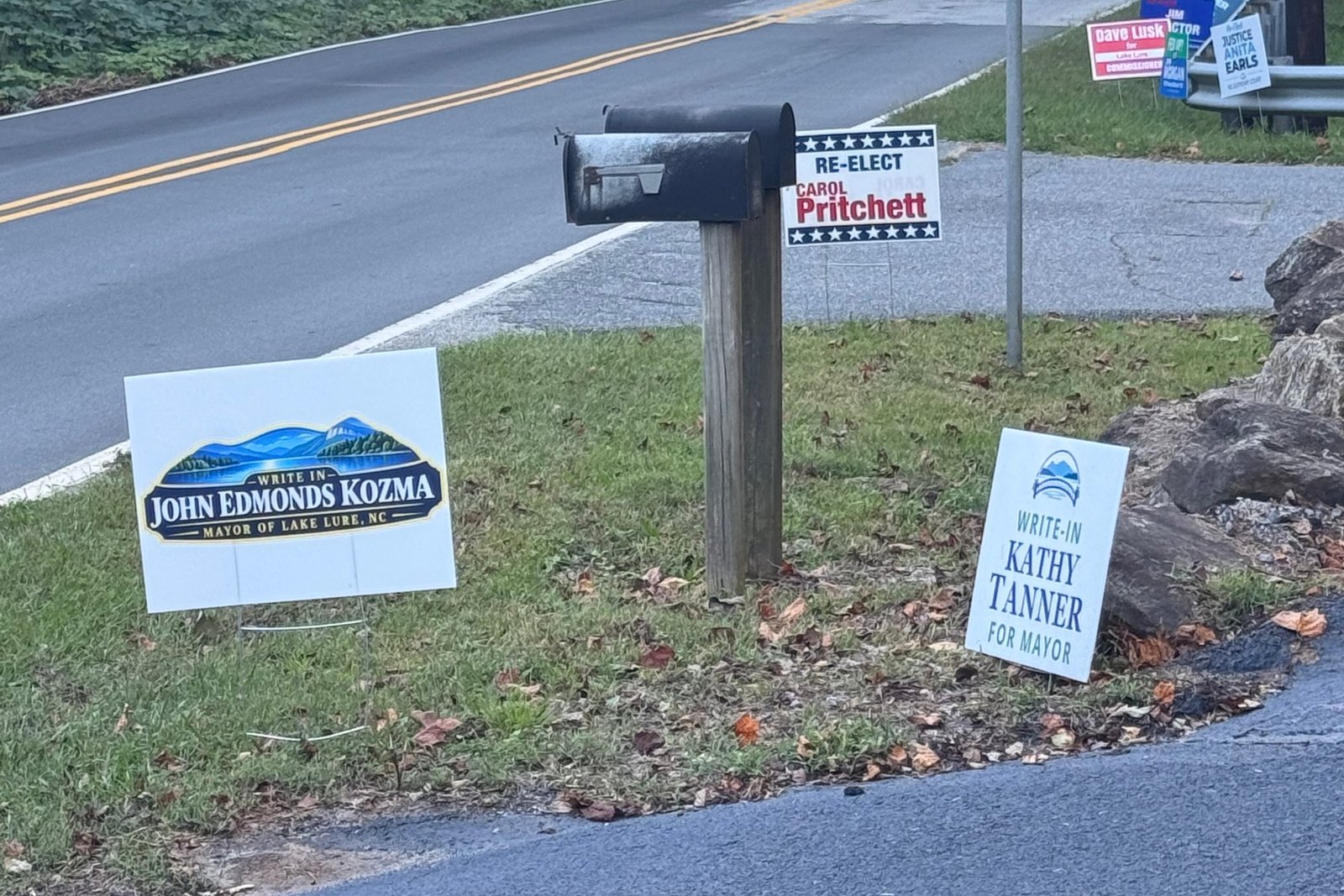
Sidebar: Lake Lure's Rules for Political Signs
Where the rule lives: Town of Lake Lure Code of Ordinances, Chapter 36 (Zoning), Sec. 36-334(3), in the sign regulations article. The Rutherford County Board of Elections also posts the Town's rules for candidates.
| Question | Answer |
|---|---|
| Do I need a permit? | No. Political signs are exempt from permit requirements. |
| Where are they allowed? | In any zoning district, on private property. |
| Where are they banned? | Public right-of-way, public property, utility poles and trees. |
| How big? | No more than 4 square feet per face, two faces per sign. |
| When do they come down? | Within 7 calendar days after the election. For November 3, that is November 10. |
| Who is responsible? | The property owner and the candidate are equally responsible for placement, maintenance and removal. |
| Setback | The county elections office's summary of the Town's rules adds that signs must sit at least 10 feet from the road edge if no right-of-way exists. |
| Message | Sec. 36-339 lets any permitted sign carry a lawful noncommercial message in place of its regular copy, as long as it meets the size and other limits. |
What that means in practice
- A standard 18-by-24-inch yard sign is 3 square feet, so it fits. A 24-by-36-inch sign is 6 square feet and does not.
- The state's 864-square-inch limit (6 square feet) applies to the state right-of-way. Lake Lure's private-property limit is stricter.
- The Town's code bars signs in "any public right-of-way," and the state statute says cities may regulate rights-of-way on streets the city maintains. Many of the busiest roads through Lake Lure are state-maintained. Whether the Town's ban or the state's more permissive window controls on those roads is a question we could not resolve from the published text. Candidates and homeowners should ask the Town's Community Development Department and, for state roads, NCDOT before planting near a highway.
- The state's removal deadline for right-of-way signs this year falls on November 13 (10th day after Election Day). The Town's private-property deadline is earlier, on November 10.
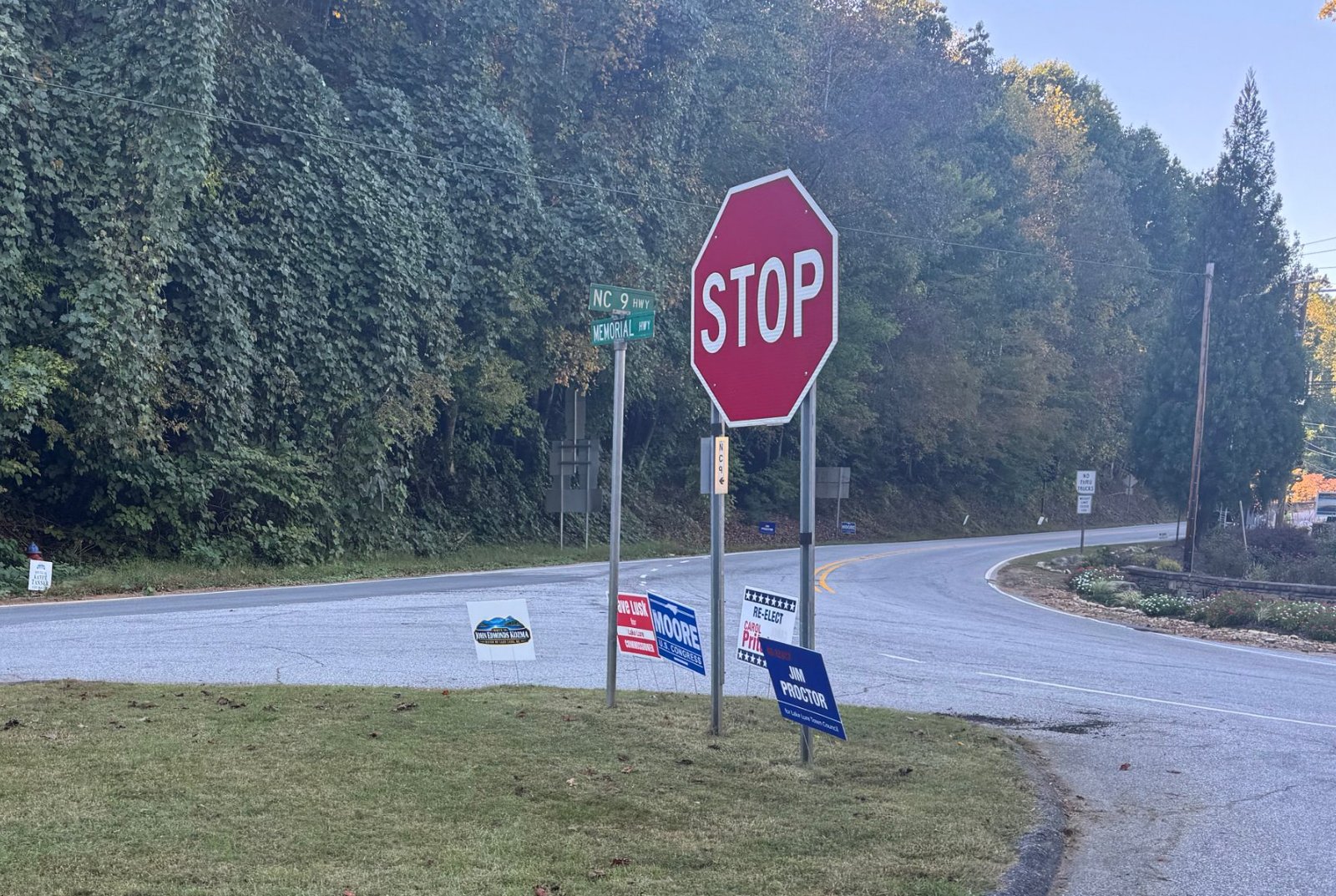
Questions about signs go to the Town's Community Development Department at Town Hall, 920 Buffalo Creek Road.
The bottom line
Yard signs are a blunt tool. Evidence suggests they don't change minds, but they do make names familiar, especially in the quiet, low-information races where most voters can't name a candidate. They also give supporters something to do and something to display, which may be as much of their value as any vote they win.
The law has settled into a rough bargain. Your own yard is strongly protected, and the government has broad authority over public land. In between, the rules have to be even-handed and, in North Carolina, they have to fit a patchwork of state statute and town code.
If you put up a sign this fall, check the size, keep it off public property, and mark your calendar. In Lake Lure, the political signs come down by November 10.
Sources
- Green, Krasno, Coppock, Farrer, Lenoir, Zingher (2016), "The Effects of Lawn Signs on Vote Outcomes: Results from Four Randomized Field Experiments," Electoral Studies 41:143-150. Yale ISPS record and Journalist's Resource summary
- Kam & Zechmeister, "Name Recognition and Candidate Support," American Journal of Political Science (2013). Vanderbilt news release and AJPS author post
- NPR/WUSF: "Campaign signs influence how we vote more than you might realize"
- Tedium: "Stop Stealing My Sign" (Burma-Shave, VictoryStore, cost figures, Mowery)
- Scientific American blog: "Post No Bills: The Ancient Romans Had a Version of Lawn Signs, Too"
- Sentinel Colorado: yard signs and sign theft penalties
- Ball State's Chad Kinsella on the "permanent campaign" (Muncie report)
- UNC School of Government, Richard Ducker, "Signs of the Times: The Regulation of Political Signs" (2011)
- N.C. Gen. Stat. § 136-32; S.L. 2011-408; S.B. 29 (2021)
- Wake County Board of Elections: NC sign statutes overview
- Lake Lure Code of Ordinances, Sec. 36-334 and Sec. 36-339
- Rutherford County Board of Elections: Rules for Political Signs in Lake Lure
- N.C. State Board of Elections: early voting
- Reed v. Town of Gilbert (2015): summary at Frost Brown Todd and Stafford Rosenbaum
- City of Ladue v. Gilleo (1994): case brief
- KXAN: legal questions about Lakeway's political sign ordinance
- University of Colorado: Politics on Display research on yard signs
- Yard Signs: Public Displays of Aggression? (wupr.org, 2020)
- TribLive: ShieldCo survey on neighbors' yard signs
- FOX 10 Phoenix: the "Battle of the Robs"
- CBS Minnesota: stolen campaign signs in Arlington
Last updated: 2026-10-14