Dignity Is on the Ballot Too: How We Treat Each Other in the Six Weeks Before Nov. 3
Opinion — Lake Lure, NC — September 21, 2026
Photo: Jesse Paul on Unsplash
This is a labeled opinion column, not a straight news report.
It is not an endorsement of any candidate or issue on the Nov. 3 ballot, and it doesn't tell you how to vote.
Six weeks from now, Lake Lure voters will cast ballots in a mayor's race with more names in it than the printed ballot shows. Mayor Carol Pritchett is the only candidate whose name is on it. Kathy Tanner and John Edmonds Kozma are asking voters to write theirs in. Before the yard signs multiply and the Facebook threads heat up, it's worth asking a question that has nothing to do with Town Hall procedure or the lake: what kind of neighbors do we want to be while we decide this?
That is the question at the center of The Dignity Voter Guide, a 12-page booklet from Dignity.us built around its Dignity 2026 campaign. It is not a guide to any candidate or issue. It doesn't tell you who to vote for, and neither does this piece. Its subject is the manner in which we do the voting, the arguing, and the posting. In the guide's own words, the whole campaign boils down to asking candidates, voters, the media, and each other: "How do we treat people when we disagree?"
The gap between what we say and what we do
The guide leans on the organization's own polling. As the guide reports it, 94 percent of Americans agree that all people deserve to be treated with dignity, meaning that their inherent worth as human beings is honored. Only 31 percent believe people are actually treated that way today. The guide also reports that about three in four Americans are dissatisfied with how we treat one another, and two in three think we are too divided to solve our problems.
The guide reads that last number as an opening rather than a verdict. If our divisions are made worse by the way we treat each other, then the fix is partly in our own hands. Nobody in Lake Lure has to wait for Washington or Raleigh to change how they talk to the person on the other side of a Facebook thread.
A scale you can use on yourself
The guide's centerpiece is the Dignity Index, an eight-point scale that measures how we treat people we disagree with. At the bottom, the other side is not just wrong but evil, a threat that has to be destroyed. A few steps up, they're the problem and we're the good people. Higher still, they're simply beneath us and not really one of us. The middle of the scale is where things turn: the other side has a right to be heard and a right to belong. Above that, you actively look for shared values, and at the top you engage fully, stay open to admitting your own mistakes, and treat everyone as having worth no matter what.
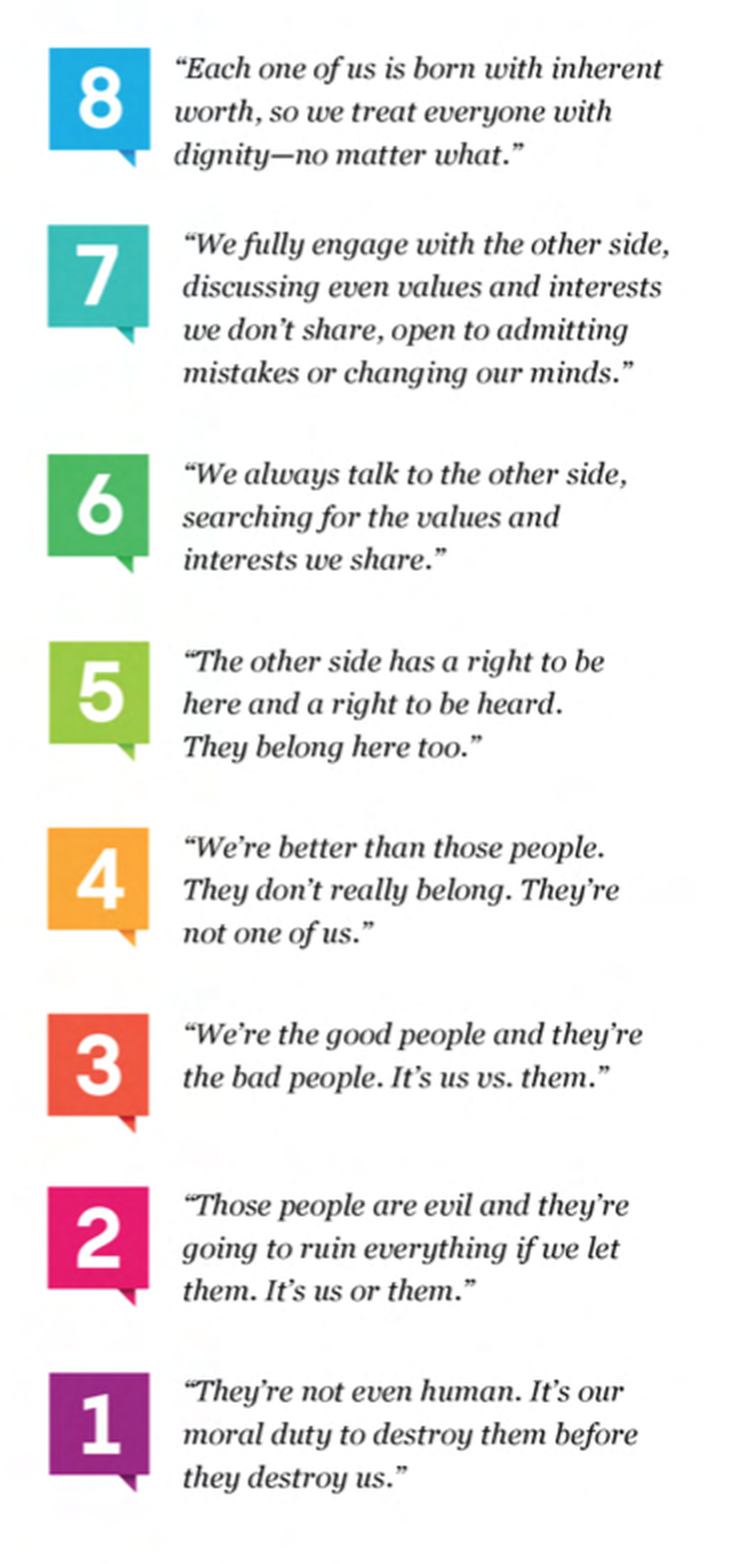
The eight levels of the Dignity Index. Graphic courtesy of the Dignity Index, © Project Unite, Inc. Learn more at dignity.us.
The guide defines contempt as looking down on someone: refusing to take them seriously, mocking them, calling them names, questioning their motives, attacking their character, or lumping a whole group together and blaming it for everything that's wrong.
That standard is worth pausing on, because it doesn't ask anyone to go easy on anyone.
Dignity is not softness
Lake Lure Insider has spent weeks asking Town officials pointed questions, pressing for public records, and reporting on a dispute that has drawn strong feelings on every side. Nothing about the dignity standard asks us to back off that. The guide is explicit that treating people with dignity does not require agreeing with them or excusing them, and that accountability is compatible with it.
If anything, the two standards point the same direction. A vote, a policy, a public statement, or a missed deadline can be examined, quoted, and challenged. A person's motives, family, or worth can't be known from a post, and speculating about them is usually where a legitimate criticism turns into contempt. The strongest thing a resident or a local outlet can do is ask specific questions grounded in documents. We've had some fun with a goat's mayoral campaign along the way, and we'd like it to stay what it is: a shared joke, not a verdict on anyone.
What this looks like on a feed
For most of us, local politics now happens on Facebook: in the community groups, in the comments under a candidate's announcement, in the reply that starts as a question and ends as a pile-on. The guide offers a set of habits for that terrain, and we'd add a few of our own. Here is how we'd put them to work between now and Nov. 3.
Argue with the record, not the person. Quote the vote, the minutes, the statement, the number. Leave out the guesses about why someone did it.
Score your own draft. The guide invites you to hold your own language up against the scale and notice when you've slipped into contempt. Try it before you hit post. If the comment would land near the bottom of the scale, the fix is usually one sentence.
Ask before you conclude. The guide includes a list of short phrases for defusing a heated exchange, most of them some version of asking someone to tell you more or explain how they arrived at their view. It is very hard to be contemptuous in the middle of a sincere question.
Look for what you share. Almost everyone in a small town wants the lake healthy, the town solvent, and their neighbors treated fairly. Starting there costs nothing and changes what happens next.
Defend the person being piled on, even if you disagree with them. This is one of the guide's more demanding suggestions, and the one that matters most in a race this small. It includes the candidate you're not voting for, and the neighbor who is.
Don't take the bait. The guide advises noticing when a post is designed to set you against another person or group, and declining to play along. Outrage travels fast online, which is exactly why it's worth pausing over.
Remember Nov. 4. This one is ours, not the guide's. The votes will be counted and the town will still be a town the next morning, full of people who read what you wrote.
What to ask the people asking for your vote
The guide also offers questions voters can put to candidates at forums, in emails, or on social media. Adapted for Lake Lure, and put to the mayor and both write-in candidates alike, they might sound like this:
- How do you plan to treat residents who disagree with you, both at the podium during public comment and in the comments on your own campaign's posts?
- What do you see as the causes of division in Lake Lure, and what are you doing about it right now?
- Do you ever contribute to it yourself, and how would you know?
- If you win, what is your plan for easing divisions? If you lose, what is it then?
- Can you name someone who disagrees with you about where this town is headed and who would vouch for how you treat them?
For anyone who knows the candidates personally, the guide suggests a more ambitious ask: invite a candidate to record a short video with an opponent answering one question, namely what they agree on. We would welcome seeing that from anyone on this ballot, printed or written in.
The guide's advice on reaching out is also worth borrowing. Keep it to three to five sentences. Share a specific moment when contempt or dignity affected you. Focus on your request rather than on your disagreements with the person you're asking. You don't have to agree with an official on a single policy to ask them to lead with dignity.
The 250th year
The guide notes that this is America's 250th anniversary, and it closes with a passage from former U.S. Sen. Ben Sasse arguing that an effective and lasting politics has to rest on the conviction that every person has inviolable dignity. You can hold any view about where the country stands and still find that idea hard to argue with when it's applied to the person across a folding table at a candidate forum.
Voting is private. The six weeks before it are not. Between now and Nov. 3, every one of us will get plenty of chances to decide which end of that scale we want to live near.
Sources
- The Dignity Voter Guide (PDF), Dignity.us — the source of the campaign question, the polling figures (as reported by the guide), the Dignity Index scale, the candidate questions, and the outreach suggestions. Summarized and adapted here, except for the scale graphic, which is reproduced with credit.
- Dignity.us — home of the Dignity Index and the Dignity 2026 campaign.
- Lake Lure Insider, "Two Write-In Candidates — and a Goat — Now Challenging an Unopposed Mayor Pritchett," for the state of the Nov. 3 mayor's race.
Last updated: 2026-09-21