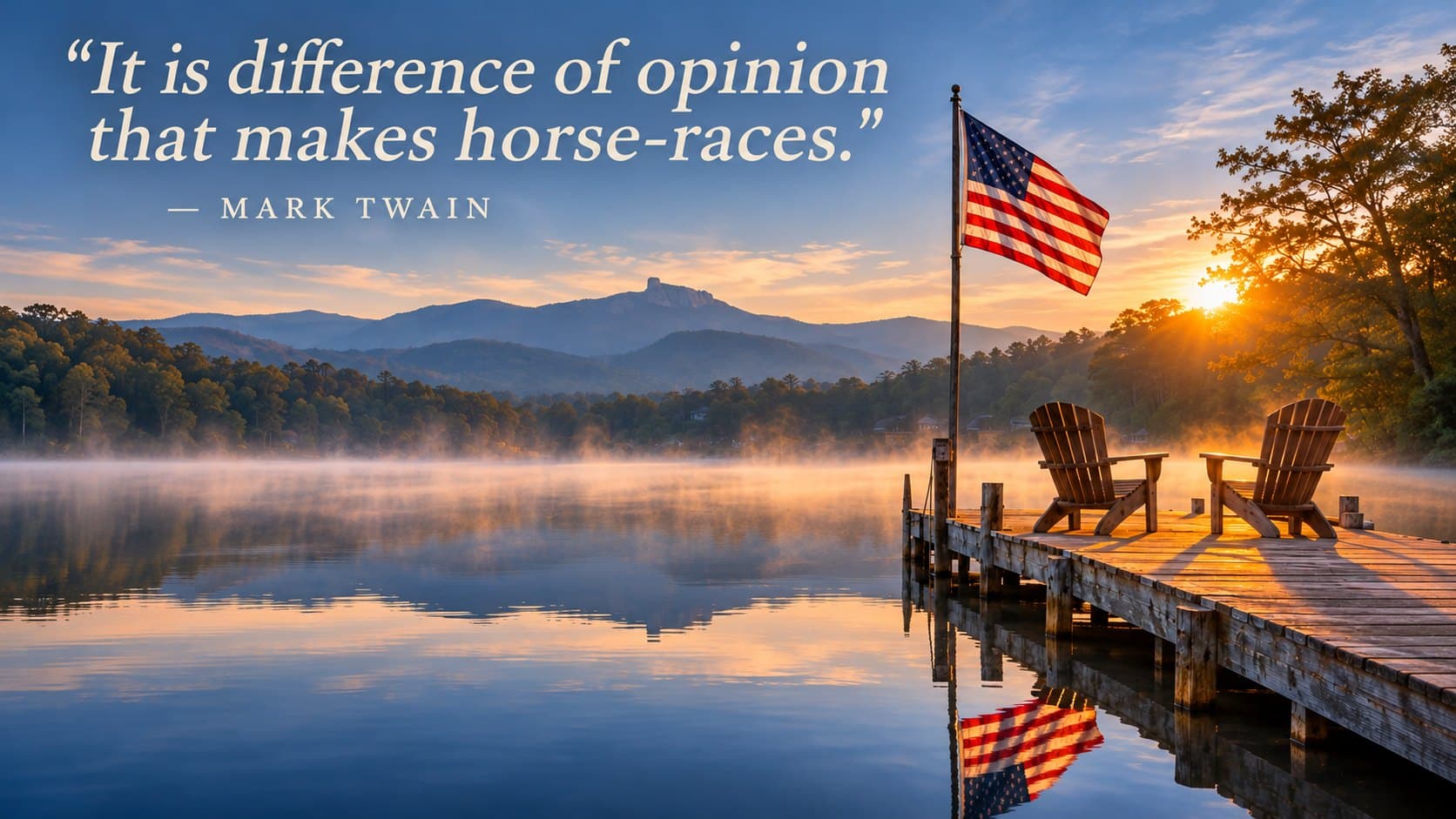
Difference of Opinion Makes Horse Races: An Election Day Letter to Lake Lure
Opinion — Lake Lure, NC — November 3, 2026
This is a labeled opinion column, not a straight news report.
It is not an endorsement of any candidate, party, or issue on today's ballot, and it doesn't tell you how to vote.
An Election Day letter on freedom, the honest question, and the neighbor who votes the other way.
Mark Twain, who could find the joke in a funeral and the funeral in a joke, once wrote: "It were not best that we should all think alike; it is difference of opinion that makes horse-races."
Today the whole country lines up at the starting gate. Here in the hills of Rutherford County we will do it the way we do most things — early, with a thermos of coffee, and with at least one firm opinion about the weather.
Polls are open 6:30 a.m. to 7:30 p.m.. Somewhere between those two hours a retired schoolteacher, a dock builder, a server coming off a double shift, and a man who has not agreed with his brother-in-law since the Carter administration will each walk into a room, pick up a pen, and do the most radical thing a free people can do. They will tell their government exactly what they think of it.
Then comes the miracle: they will go home, and the government will have to listen.
That is worth a moment of pride before it is worth a moment of argument. So before the yard signs come down and the results come in, this is a thank-you note — and a small invitation.
A fragile thing
On January 5, 1967, a new governor of California named Ronald Reagan used his inaugural address to remind his audience that freedom is "never more than one generation away from extinction." It is not inherited like the family silver, he argued. Each generation has to choose it again.
He said it on the very day he was handed power — which is exactly the right day to say it. The moment someone takes office is the moment everyone should remember that the office is on loan.
Freedom, it turns out, is less like an heirloom and more like a lawn: it does not keep itself, it grows back stubborn, and every neighbor has a theory about how it ought to be tended.
Lake Lure knows something about fragile things. We have watched water take what we assumed was permanent, and we have watched neighbors put it back, plank by plank and road by road. Anything you have had to rebuild, you never again take for granted. A democracy is no different. It is not a monument. It is a barn raising — and today is one of the days the whole county shows up with a hammer.
The right answer
In February 1958, a young senator from Massachusetts stood before an alumni banquet in Baltimore and urged his listeners to seek "not the Republican answer or the Democratic answer, but the right answer." John F. Kennedy was a Democrat, in a midterm year, campaigning for Democrats when he said it — which is precisely what makes it worth repeating.
Five years later, at Vanderbilt University, he put it another way: "the ignorance of one voter in a democracy impairs the security of all."
That line is often read as a scolding. Read it again and it is a compliment. Your vote matters so much that your homework matters too. Nobody bothers to inform a person whose voice doesn't count. The country asks you to read the sample ballot because the country genuinely needs your judgment.
Give them hope
In June 1978, Harvey Milk — California's first openly gay elected official, a San Francisco supervisor who had lost three races before he won one — stood on the steps of City Hall and told the crowd that the people who felt shut out of public life, whom he called "the us'es," needed more than policy. They needed proof that the door was open. "You have to give them hope," he said.
Here is the part of the story that rarely makes the bumper sticker. That same year, a ballot measure in California would have barred gay teachers from public schools. Ronald Reagan — conservative, former governor, about to run for president — publicly opposed it. Milk and Reagan agreed on very little. On that question they stood on the same side, and the measure went down to defeat.
Differences did not keep them apart. Their differences are what made the agreement mean something.
A question is not an insult
There is a strange idea loose in the country that asking a question is a hostile act. It is not. A question is a citizen doing the job the Founders assigned. The First Amendment protects not only the right to speak, but the right to petition the government for a redress of grievances — a lawyerly phrase for walking up to the microphone during public comment and asking, "Why?"
An honest answer has never once been harmed by a question. Only the other kind has reason to be nervous.
Two very different broadcasters have been making versions of this point for years.
Michael Smerconish left the Republican Party in 2010 and has described life as the guy in the middle as "lonely" — yet he insists he speaks for most Americans, not a fringe. He has pointed out that roughly 45 percent of U.S. adults now identify as independents, and he blames much of our polarization on what he calls "men with microphones," a media business that profits from keeping us angry. His remedy is charmingly old-fashioned: his Mingle Project encourages listeners to organize local meetups where people of different backgrounds and politics sit down and talk. At least one couple who met at a Los Angeles meetup ended up married. That is more than most cable panels can claim.
Bill Maher comes at it with a sharper knife. After a past midterm, he cited reporting that the true extremists make up only about 7 to 8 percent on each side yet soak up most of the attention, and he called on the reasonable majority — "the normies" — on both sides to marginalize the bad-faith fringe in their own camps and "form a less psycho union." This fall he added that the two parties battling it out is simply how the system is meant to work.
You may love one of those men and switch the channel on the other. That is rather the point. Both are saying the same thing from opposite ends of the dial: most of us are more reasonable than our feeds suggest, and the fight is supposed to be about ideas, not about each other.
A thank-you note
So, before the returns come in, some gratitude.
To the poll workers — our neighbors who will be up before the roosters and on their feet past supper, checking names, explaining the scanner for the four-hundredth time, and doing it with a smile. Democracy's most important people are not on television. They are behind a folding table in a fellowship hall.
To the candidates — every one of them, on every line of the ballot. Putting your name on a yard sign means accepting criticism, scrutiny, and the occasional rude comment at the gas station. Whether they win or lose, they did something most of us never will. They raised their hand.
To the people who ask hard questions — at council meetings, in letters, in records requests, at the end of the pew. You are not troublemakers. You are the maintenance crew.
To the neighbor who votes the opposite of you — thank you for showing up. A ballot box with only one opinion in it isn't an election. It's an echo.
And to the veterans among us, whom we honor next week — every ballot cast today is a receipt for a debt we can't fully repay.
The morning after
Tomorrow some of us will be pleased and some of us will be sore. Either way, the lake will still be there, the Rock will still keep watch over the gorge, and Edmund the goat — who has never registered with either party — will spend Wednesday exactly as he spent Tuesday.
In that same 1967 address, Reagan remarked that what happens when power changes hands is almost commonplace in American life — and yet, to most of the world across most of history, it would look like a miracle. He was right. The quiet handoff, the concession call, the losing side going home to try again in two years: we have done it so many times we forget it is the rarest thing in the world.
So vote. Then do the second most patriotic thing an American can do: go find someone who voted differently, and buy them a cup of coffee. Ask them why. Actually listen to the answer. You won't change each other's minds over one cup. You might change each other's opinion of each other, and that is where every good change begins.
Harvey Milk ended his most famous speech by pointing out into the crowd: and you, and you, and you. He meant that hope is not something you wait to be handed. You hand it to somebody else.
The horses are at the gate. The difference of opinion is what makes the race worth running.
See you at the polls.
Last updated: 2026-11-03